AI has rewritten what a data center needs to be. The rack densities that used to sound aggressive now barely register, and the traditional stick build method can't keep up. Modular builds flip that model, building the hard parts in a factory, testing them before they ship, and connecting them on site instead of assembling them there.
Heat rejection is one of the least glamorous parts of any AI data center build, but it’s just as critical as power and compute. In a traditional data center build, heat rejection is handled with a field-built chiller plant, specified per project, assembled by mechanical contractors, and coordinated with every other trade on your site.
We built our modular chiller to take that scope entirely off your site.
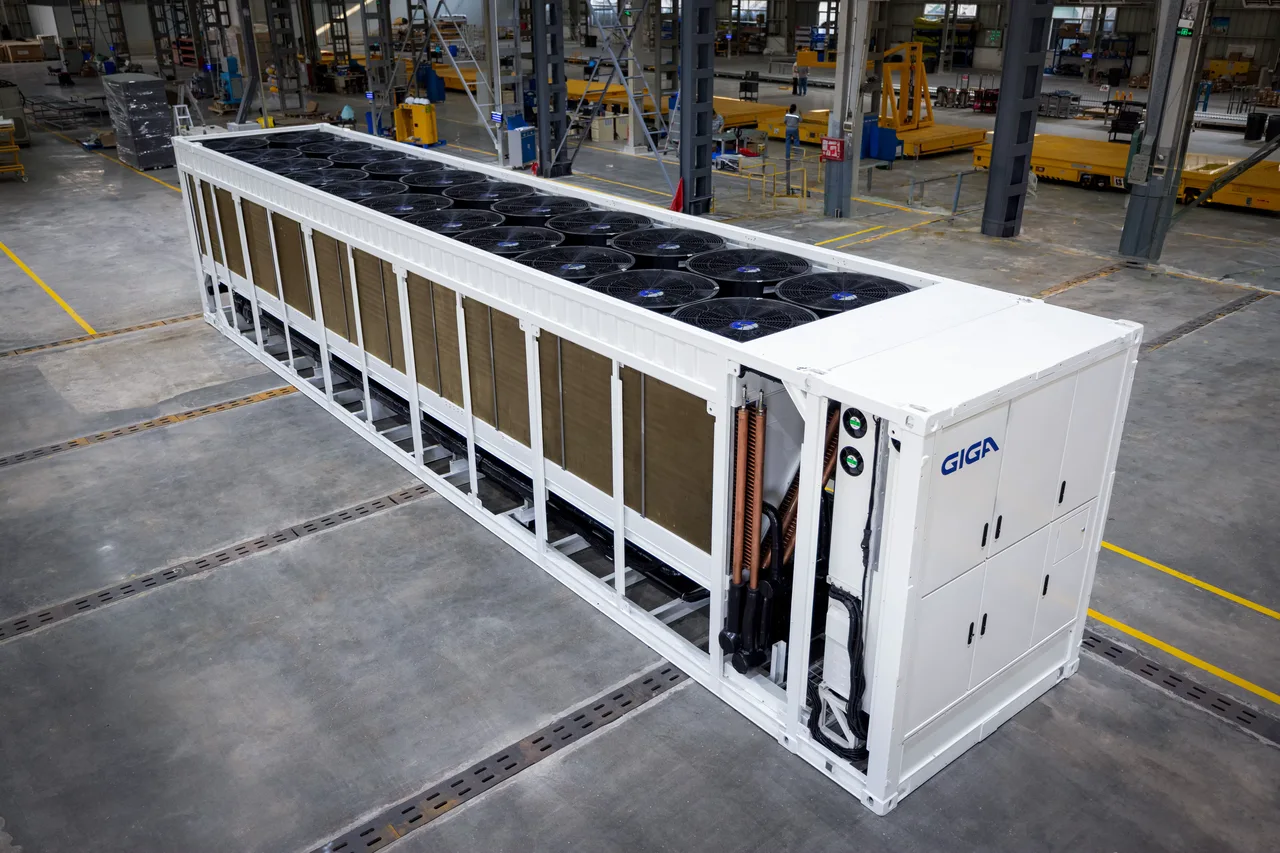
Our chiller is a 2 MW heat rejection unit that ships from our factory pre-built and pre-tested, just like every component in the GigaBase system. It arrives, you connect it, and the water loop that keeps your compute alive is running. But how does Giga’s modular chiller work?
In this post, we'll cover what the modular chiller is, how its hybrid design pairs dry cooling with mechanical cooling, and where it fits in the rest of the GigaBase system.
What is a modular chiller?
In a traditional data center build, the chiller plant is in its own league. Every component (chillers, pumps, VFDs, valves, and instrumentation) gets specified and procured separately. In the field, multiple trades have to rig and set the equipment, install the instrumentation, pull wire, terminate, program, and then finally commission it as a system.
Every one of those handoffs creates a chance for the schedule to slip. Cooling gates commissioning: no heat rejection, no load banks, no integrated systems training, no handover. Our modular chiller solves that problem by taking the build out of the field and into our factories.
It's an air-cooled heat-rejection unit that maintains the GigaBase water loop at the required temperature. The module's rated capacity using PG25 is 1.9 MW with 22 °C (72 °F) supply and 33 °C (92 °F) return, at 35 °C (95 °F) ambient dry bulb.
It's built for uptime, too. Leak detection, dew point monitoring, and variable frequency drives all come standard, with SNMP and Modbus TCP monitoring and a 10" HMI panel so your operators can see exactly what the unit is doing at all times.
The best part is that nothing about the modular chiller requires field assembly. It arrives at your site as a single unit, already tested on our factory floor. Contractors are only required to make the final power, controls, and piping connections.
Read more: A guide to AI data center cooling equipment
Two cooling modes, one module: dry and mechanical
The modular chiller contains two cooling modes:
- Dry cooling is the simple half of the equation. Fans pull ambient air across the coil, extracting heat from the facility water as it passes through and rejecting that heat to the atmosphere. Much of the industry calls it “free cooling” because no compressor is used in the heat rejection process.
- Mechanical cooling utilizes a compressor to extract heat from the facility water and rejects it to the atmosphere using the same fans.
Free cooling can't cover every hour or every load. That's why GigaBase sites deploy both: dry coolers carry the loop most hours of the year, and compressors engage only when high ambient temperatures or a lower facility water temperature is required.
How the modular chiller connects to the white space
To explain how the modular chiller connects to the rest of your equipment, all we need to do is follow the heat.
Inside each of Giga’s pre-commissioned compute modules, your racks dump heat into the fluid loop. The CDUs pull it off the cold plates, the fan walls pull it out of the air, and it all ends up as heated fluid that needs somewhere to go. The modular chiller then serves as the outdoor end of the loop, rejecting the heat your compute generates so the fluid can head back inside and do it again.
Our zero-waste system is one singular loop that runs from rack to chiller and back again.
If you want the full picture of the loop's indoor half and our compute modules, our GigaPod post walks through the CDUs and fan walls in detail. And for how every module fits together, start with our GigaBase deep dive.
Giga’s data center chiller, built for AI compute
Heat rejection is a critical part of any data center build, and if you’re building the traditional way, it can hold your entire project hostage. The modular chiller removes this bottleneck by shipping as a fully integrated and commissioned product. We build, test, and prove the system on our factory floor rather than in the field, saving you time and money.
The modular chiller is data center infrastructure innovation at its finest, and it’s only one piece of the GigaBase system. If you want to see how the whole system fits together, get in touch with the Giga team to talk through what a GigaBase deployment could look like for your project.
.png?w=1280)