
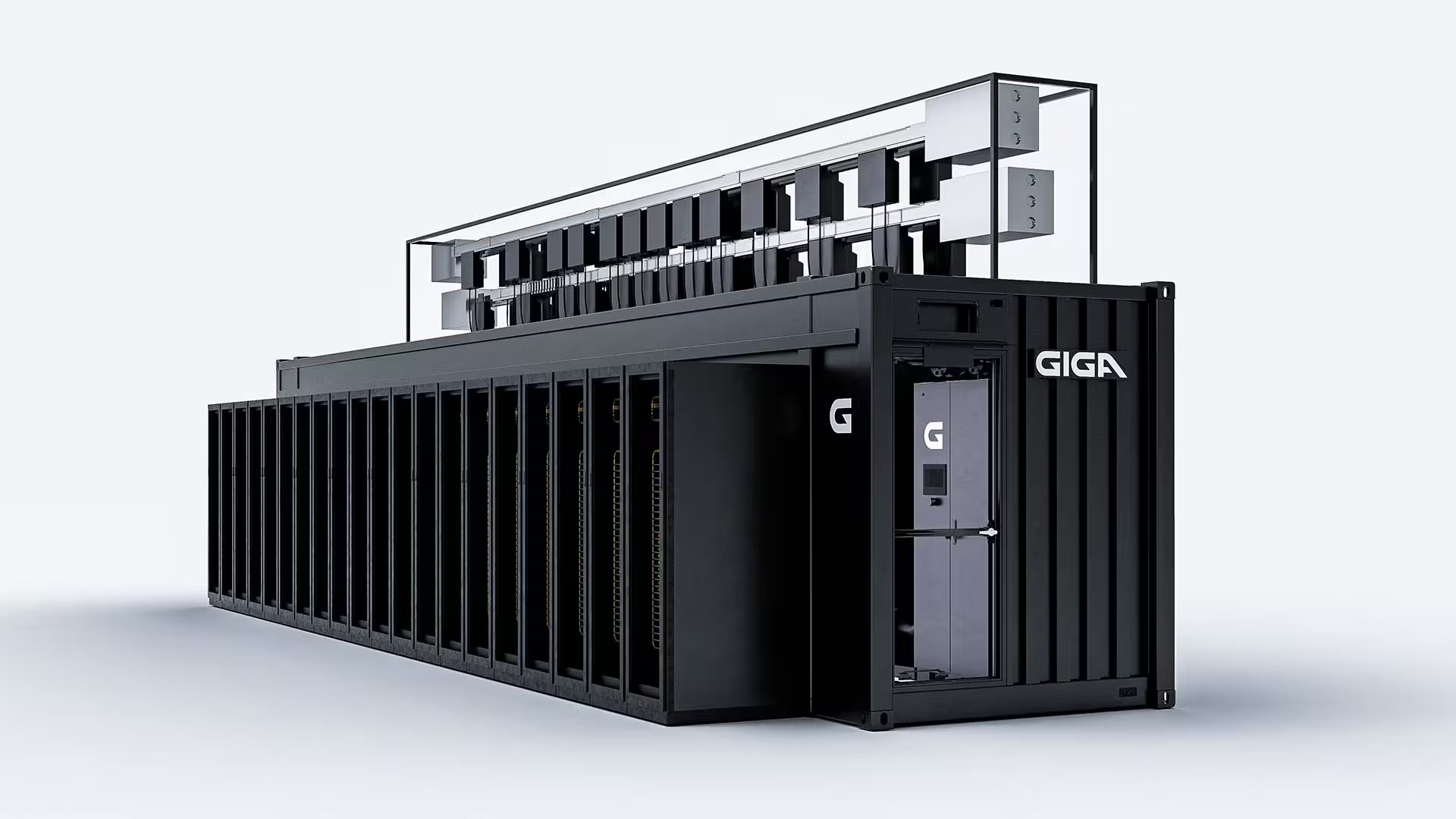
Everyone is racing to deploy more GPUs, and if you want to stay at the forefront of that race, you need to understand not just the GPUs themselves but what it takes to run them.
Building GPU infrastructure for AI starts long before a chip is ever installed. It starts with land, power, and the electrical equipment to deliver that power reliably at the density AI compute demands. If you get that part wrong (or just get it late), your GPUs sit idle, costing potential revenue every day.
Understanding the compute layer is only one piece of the puzzle. This post breaks down what GPU infrastructure is, how AI systems are architected, and what the physical AI site and power requirements look like for teams looking to deploy at scale.
What GPU infrastructure means for AI
GPUs weren’t originally built for AI. It stands for graphics processing unit, and its original purpose was to render graphics. However, a GPU’s ability to run thousands of calculations simultaneously rather than sequentially made it the obvious choice for training and running AI models.
We know that the parallel processing capability allows a single GPU to do in minutes what would take a CPU several hours, but most explanations stop there, leaving out a key detail: a GPU is only as effective as the infrastructure behind it.
GPU infrastructure includes the full system that supports it: compute, networking, storage, cooling, and the electrical equipment that delivers high-density power to your racks.
At the scale AI demands, power is often where projects get stuck. AI training clusters now routinely require tens to hundreds of megawatts. The GPU supply chain has improved. The energy infrastructure supply chain hasn't kept pace.
The real bottleneck has now moved from getting GPUs to getting the MWs to run them. Let’s dive a little deeper into the details of GPU clusters and how you can reliably power them.
Read more: Planning a data center deployment: A step-by-step guide
The core components of a GPU cluster
The core component of any GPU cluster is the GPU itself. Some of the most popular units as of writing this are NVIDIA’s H100, H200, and B200. These units have high core counts, massive memory bandwidth, and are specifically designed for the math that underpins deep AI training and learning.
Connecting those GPUs is an interconnect fabric. Technologies like InfiniBand and NVLink create high-speed links between GPUs within a node and across nodes in a cluster. This matters more than most people realize, because latency in the interconnect can become the limiting factor in a training run, regardless of how powerful the individual GPUs are.
Feeding all of that compute is storage. Distributed, high-throughput storage systems have to deliver data at the rate GPUs can consume it.
Cloud providers cover this architecture well when the deployment lives in their environment. But if you're building your own colocation facility or deploying on-premises, you’ll need to specify the infrastructure, source equipment, and stand up the site yourself.
Power and cooling layers
AI data centers operate on a fundamentally different power density than traditional data centers, and that density requires specialized infrastructure. You’ll need custom high-capacity transformers and UL-listed switchboards to manage power delivery to your high-density racks.
Next, consider your cooling layers. Liquid cooling, such as direct-to-chip solutions, are critical for GPU-dense deployments. Air cooling is not sufficient for deployments at this density, so be sure to invest in the right cooling infrastructure for your build.
Many deployment plans stall because of long lead times on transformers, switchboards, and other key infrastructure. The power and cooling layers are critical to your GPU and data center infrastructure, but if you’re not working with a fully vertically integrated partner, you run the risk of letting your project fall behind.
See how Giga Energy stands up new data centers in 9 months.
AI architecture: Training vs. inference environments
Your site design and GPU infrastructure will vary depending on whether you’re building a training or inference environment.
Training clusters are large, power-hungry, and they run hard. A model training run can push a cluster to full load for days or weeks at a stretch. Power stability and density are particularly critical in these clusters, as voltage fluctuations and thermal instability can compromise the training run entirely.
Inference environments operate differently. Demand follows user traffic, which means load is variable and sometimes unpredictable. That variability creates opportunities in flexible load participation and demand response strategies if you know how to use them.
In both environments, the architecture decisions made on the compute and networking side cascade directly into site and power requirements. Cluster size, networking topology, and cooling approach all determine what kind of electrical infrastructure you need, how much power you have to source, and what your site has to be capable of delivering.
What to look for in an infrastructure partner
Not every data center infrastructure partner is built the same. Here's what actually matters when you're evaluating who to work with.
- Look for a manufacturer, not a broker: Transformers and switchboards are long-lead items. A partner who sources from third-party OEMs is subject to the same lead time constraints you'd face on your own. A partner who manufactures the equipment themselves, like Giga, controls the timeline.
- Find a fully integrated partner: Fragmented vendor structures (separate EPC firm, separate equipment manufacturer, separate utility partner, etc.) multiply handoffs and diffuse accountability. When something slips, everyone points at someone else. A single partner who owns the full process streamlines your build and cuts out that finger-pointing.
- Look for someone who can handle site origination: Site origination capability separates real infrastructure partners from contractors. If your partner needs you to show up with a permitted site and available power, they're not solving the hard part of the problem.
- Partner with an experienced operator: Partners who have built and run their own sites understand what the operational reality looks like after commissioning, which helps them build better, more reliable sites from the ground up.
Your GPU infrastructure needs to be able to handle the loads your AI data center will run, and choosing a vertically integrated infrastructure partner, like Giga Energy, can get you there faster and more reliably.
Building GPU infrastructure with faster time-to-power
GPU infrastructure is a hardware problem, a software problem, and an energy problem. Most planning gets the first two right and gets blindsided by the third.
The teams moving fastest on AI build-outs aren't just buying better chips. They're partnering with infrastructure providers who can source the MWs, manufacture the equipment, and stand up the site without the pain and irritation of multi-step handoffs.
If you're planning a GPU deployment and the site and power picture isn't clear yet, that's exactly where we start.
.png)


.avif)