.avif)
I've spent my career working on whichever constraint matters most. I joined Giga because the constraint moved again.
For years, the constraint in energy was delivery. Across the industry, projects stalled in the long chain of handoffs between groundbreaking and energization. I spent years on the buying side of that process and watched execution delays ripple across hundreds of megawatts of development. This spring, I sat down with Giga co-founder Matt Lohstroh, armed with five pages of questions about the company. Halfway through our conversation, I stopped asking them.
Why? Because I’d realized that the most critical question wasn’t one Matt could answer; it was one I had to answer myself. If time-to-power is becoming the binding constraint on compute, where would I rather stand than inside a company moving critical electrical work off the job site and into a repeatable factory process?
I wanted to be inside the company solving that constraint directly, helping build what it needed to scale. That's what brought me to Giga.
What to do when the constraint moves
Every company I've helped build was a bet on the same idea: at any given moment, one constraint matters more than the others, and the most valuable work is building the capacity that removes it. Every few years, the constraint moves. When it does, the map of where value gets created is redrawn.
When I was at Curative in 2020, the country needed COVID tests on a scale that didn't yet exist. By tackling that constraint head-on, Curative grew from a handful of people into a company of thousands, with laboratories running around the clock and a national delivery network. The lesson I learned there was that when demand outruns supply, operating capacity becomes a product in its own right
The next version of that problem took me into energy. As Chief Commercial Officer of US Bitcoin Corp and then Hut 8, and later as CEO of Ionic Digital, I lived on the buying side of power infrastructure across hundreds of megawatts.
For bitcoin miners, every week a megawatt sat unenergized was revenue that never arrived. That meant that miners carried the financial risk of every project delay. Living with that risk taught me exactly where projects break: in the long chain of handoffs between everyone who has to touch a project on its way to energization.
Then, in 2025, we launched American Bitcoin. I ran it as CEO through its Nasdaq listing that September, then served as President and interim CFO. The bottleneck had moved again, this time to capital. The ability to finance speed had become production capacity. You can be right about the asset and right about the market and still lose to whoever can fund the build faster.
My career has been about recognizing when the constraint moves, then building the capital, teams, and operating systems needed to remove it. That is what ultimately brought me to Giga.
How I found Giga
I found Giga by watching my own industry from the inside.
I saw the AI buildout’s infrastructure constraints early because bitcoin sites were already encountering the same substations, interconnection queues, and transformer lead times.
Giga was already a name I knew at the time. Matt and Brent Whitehead started the company as students at Texas A&M, mining bitcoin from their own modular sites in the Texas oilfield. I knew their story and knew that every time a bottleneck slowed their delivery, they moved upstream to own the piece causing it.
They built their own containers, then started manufacturing transformers and switchboards, then expanded into pre-engineered, scalable data center systems. I recognized the pattern right away: they were taking the same approach I've leaned on at every stage of my own career.
Find the constraint, then move upstream until you’re solving it. Matt and Brent had already built the industrial engine. I saw the opportunity to help build the enterprise around that advantage.
The view from the buyer's side
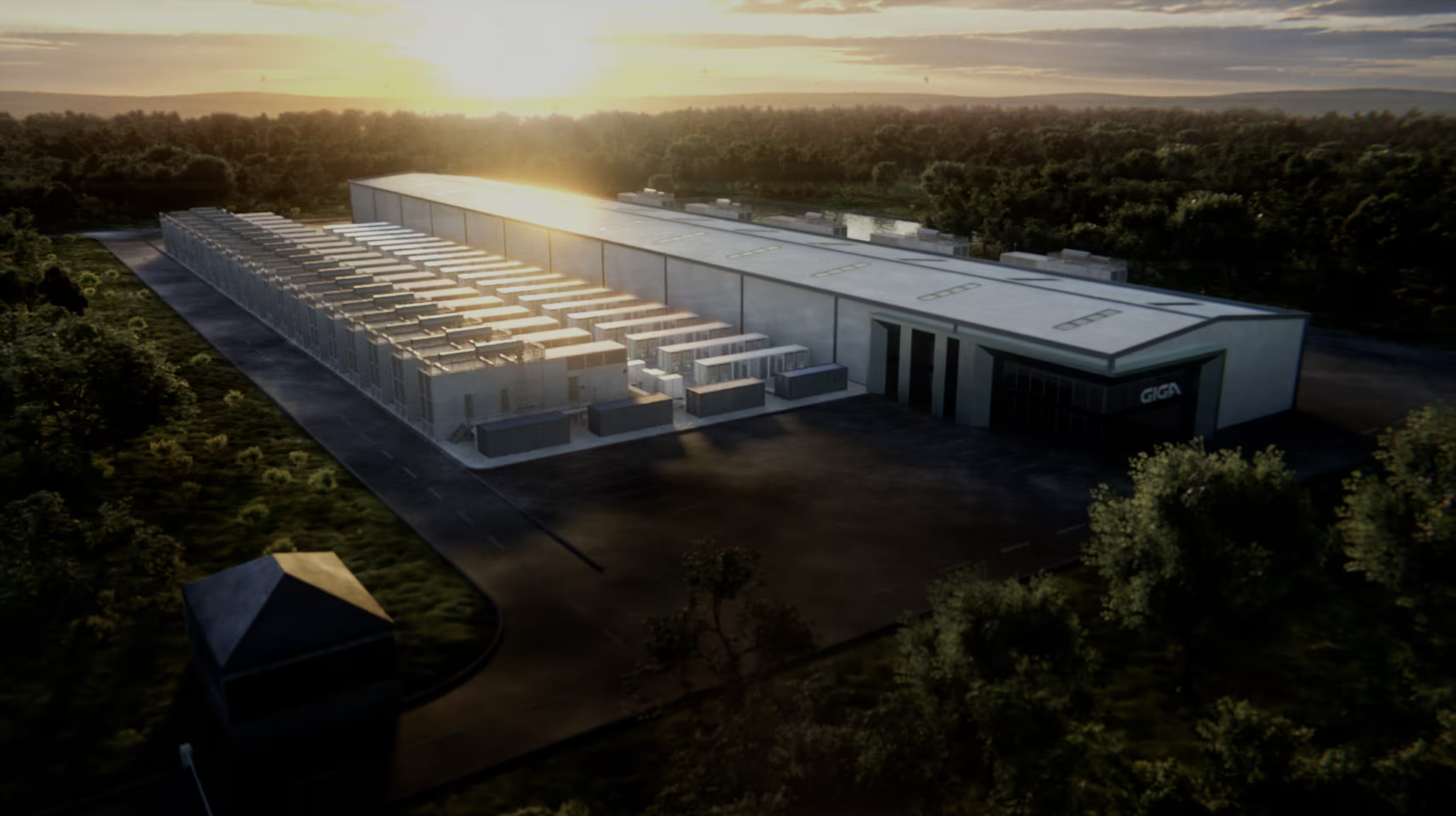
Giga makes transformers, switchboards, and modular full data center systems for the new AI factories. The model moves most of the engineering and assembly work off the job site and into the factory, cutting the field labor (and uncertainty) in the equipment and integration scope.
When I was on the buyer’s side, I waited on transformers. I've sat through the call where an energization date slips one more quarter, and the explanation lives two handoffs upstream. Putting the equipment package on one accountable factory schedule gives buyers something they rarely get: a delivery date solid enough to build financial models around, the same way they diligence interconnection, permitting, site readiness, construction, and commissioning.
Giga’s model turns critical electrical equipment and integrated systems into factory-built products with defined delivery milestones. It doesn't erase the rest of the project, but it makes one of the hardest parts of the project legible and accountable.
What I'm here to build
Giga’s factory mandate creates a corresponding enterprise mandate. As Chief Business Officer and interim Chief Financial Officer, I’m here to build the platform around that advantage: the capital, talent, risk architecture, and digital systems that allow the company to scale with speed and discipline.
Giga has more opportunity than any company can pursue at once. Part of my role is to help identify the highest-leverage opportunities, shape where we focus, and build the machinery each priority requires.
I’m coming into my role at Giga with three priorities.
- Capital: Giga’s opportunity is capital-intensive. I’m here to connect enterprise planning, project finance, private capital formation, and capital allocation so that financing capacity does not become the next constraint. That includes building the relationships and transaction capacity required for Giga’s next stage.
- People: In hypergrowth, every hire is a capital-allocation decision. I’m here to help put the highest-leverage people in clearly defined roles and build an organization that can scale without losing judgment, ownership, or speed.
- Systems: Finance, legal, planning, and digital operations are the machinery underneath the product. I’ve built that machinery before. At Giga, my job is to build the operating architecture that keeps pace with the promises the product makes.
Across all three, my job is to build the operating architecture that connects strategy to execution. Success is not centralizing every decision; it is giving the teams that own customers, products, technology, and delivery the capital, talent, information, and operating clarity to move faster.
Why join Giga now
In prior seats, I usually saw the problem before the right company existed, or found the company after the market had already caught on. This time, both arrived at once.
Demand for energized compute has durable drivers, and the companies defining how that capacity gets delivered are being built right now, on factory floors, by people who think in weeks.
The constraint will move again. It always does. For now, the opportunity is to turn a factory advantage into an institution capable of compounding it. That is the work I came to Giga to do.
.png)
.avif)