.avif?w=1280)
There's a version of this post that opens with my resume. I'm going to skip most of it, because where I've been matters less than the problem I kept running into at every stop, and why Giga Energy is the first place I've found that can actually do something about it.
The infrastructure model for data centers was never designed to withstand the pressure now being placed on it. AI demand isn't slowing down, and legacy delivery models can't build fast enough to meet it. The volume of infrastructure the industry needs to stand up in the coming years far exceeds the number of skilled hands available to build it the traditional way.
If we want to meet that demand, we need more than a scramble to train people to do things the old way. We need a new model that scales with speed without sacrificing control over engineering quality.
That's what brought me to Giga.
Four stages, one pattern
My career has tracked one continuous problem: how to deliver infrastructure faster as the demands keep escalating. Each chapter taught me a different piece of the answer.
I started consulting on semiconductor manufacturing facilities, where the governing philosophy was copy-exact. Consistency was the product. If a process worked in one fab, you reproduced it identically in the next. Standardization was how you controlled variability at scale.
At Tesla, the problem flipped. We were building the first Gigafactory, and there was no reference design to copy. The only path forward was first principles; understanding the manufacturing process from the ground up (how much heat, how much energy, how much process load goes in) and designing the infrastructure to match it efficiently. We figured out how to build something that had never been built before. But we did it one factory at a time.
Google was that problem at a different order of magnitude: a design that had to deploy concurrently across numerous sites. We made strategic decisions about where to cut in new technology and engineering decisions to simplify the design — the best part is no part — and we chopped the infrastructure into smaller blocks that could be prefabricated in a controlled environment. It was real progress. But it still required a significant amount of skilled labor in the field to assemble the blocks into a working data center. That dependency is the ceiling we kept hitting.
In every role, the hardest part was never the engineering; engineering problems are always solvable. The harder problem is that the systems we use to deliver energy infrastructure were never designed for the speed and scale now being asked of them. I was doing everything I could within the constraints of that model. But the constraints themselves are the problem. The delivery system is the bottleneck, and no amount of talented engineering inside a broken one can change that.
The AI buildout has pushed scale past the point where field labor can keep up. There aren't enough electricians, pipefitters, and commissioning technicians in the country to construct AI data centers at the pace the workload demands. The only way through is to take what we learned at Google one step further. Two things have to be true:
- Modules have to be standalone buildable units. They need to be manufactured, integrated, and commissioned independently in a factory environment, not a job site.
- The glue between modules has to be engineered as a product itself. They should be well-defined connection points that allow modules to snap together in the field without re-engineering the system each time.
That's the shift from constructing data centers to manufacturing them. And that's what I was wrestling with when Giga came across my radar.
How I found Giga
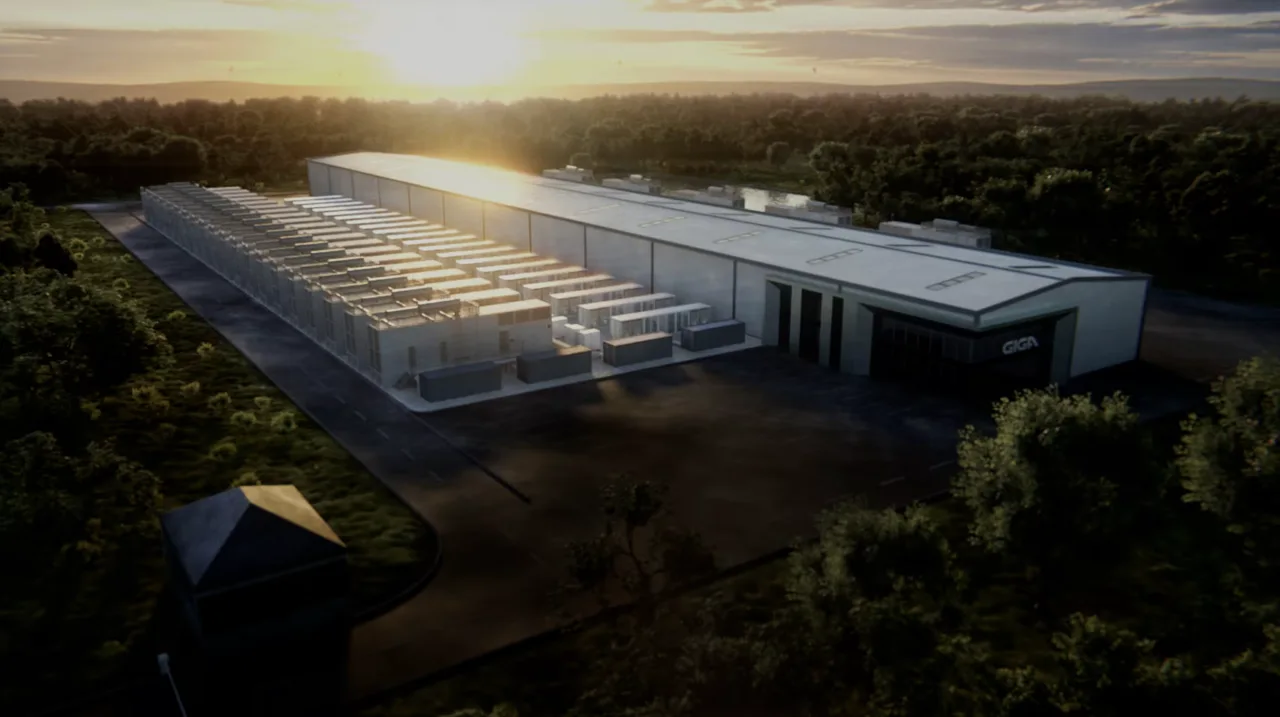
I came across the Hydrobox, Giga's bitcoin mining container. It was the simplest possible expression of where I knew the industry needed to go: a single unit hosting power distribution, compute, and cooling, with one power connection and one network connection at the site boundary. Everything else lived inside the box.
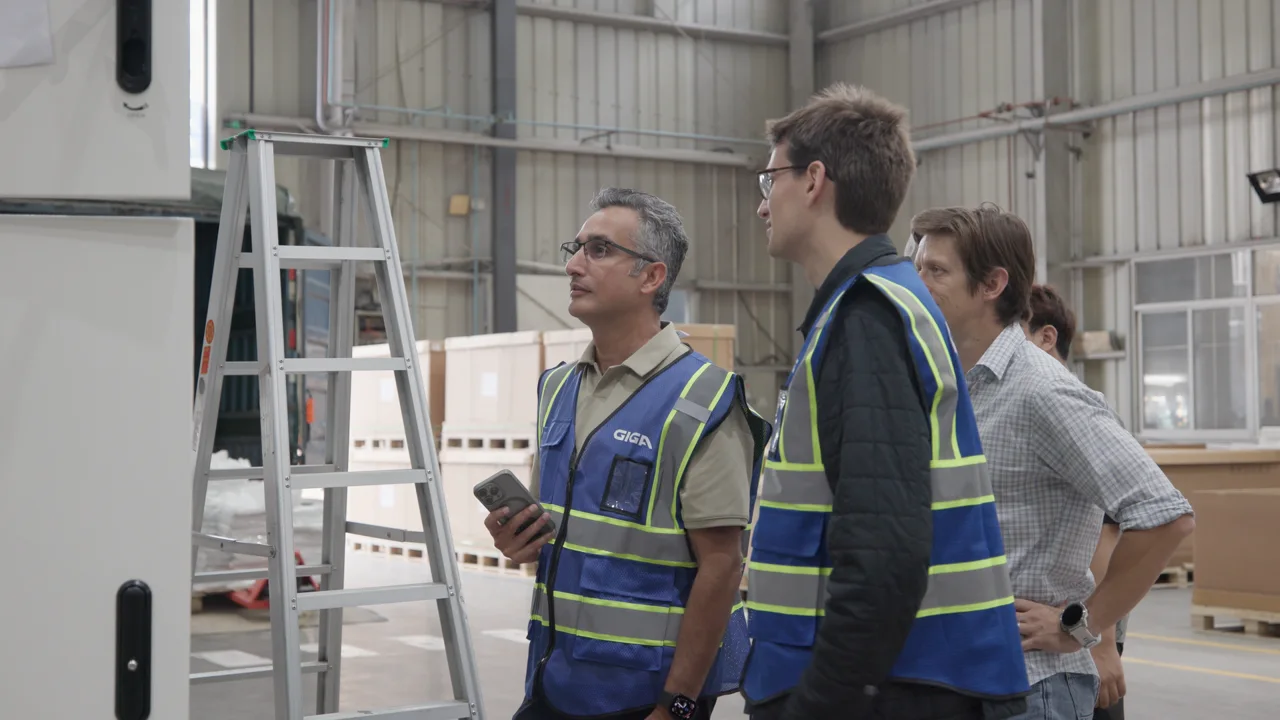
A product photo only tells you so much, so I went to see it. I visited the factories in Long Beach and Houston and spent time with the team. What I found made me more interested, not less. Instead of designing something clever and outsourcing the rest, Giga owned the full process, with in-house engineering, manufacturing capacity, logistics, and a team that delivered, installed, and commissioned its own products.
That last point is what changed my thinking. The gap between "we shipped it" and "it's operational" is where most projects fall apart. Giga's model closes that gap by keeping the entire delivery chain under one roof.
At Google, I led an initiative exploring this pre-integrated approach. Giga was already doing it.
The question I asked myself was simple: if I were building this company from scratch, is this the model I'd choose? The answer was yes.
What Giga actually is
The clearest way to describe Giga is by what it replaces. A traditional AI data center build distributes work across an equipment OEM, a general contractor, a commissioning partner, and an engineering firm to tie it together. Each of those vendors owns a piece. None of them owns the outcome.
Giga is all of them in one company. We own the vertical supply chain that an AI data center requires (medium-voltage switchgear, transformers, dry coolers, CDUs, generators, and the white-space modules themselves) and the engineering, permitting, manufacturing, construction, and commissioning capabilities to deliver them end-to-end. Giga turns the full process into one team and one accountable timeline, removing the hand-offs where project timelines can fall off-track.
That's the model the AI era requires, and it's why I joined.
What I'm building
My job is to take what this team has built and make it scale. Four priorities.
Keep simplifying the stack. The Hydrobox showed what's possible when you collapse power, compute, and cooling into one integrated unit. We'll keep pushing in that direction by attacking inefficiencies that don't need to exist, eliminating power-transformation steps from utility to chip, and eliminating heat-rejection transfers from chip to ambient. Every conversion stage we remove is a stage that can't fail, can't waste energy, and can't slow a build down.
Move work from the field into the factory. The more pre-fabrication, pre-integration, and pre-testing we do before a module leaves the floor saves time on site. The skilled labor constraint isn't going away, and if we want to keep building AI infrastructure at the pace we need, we have to change construction processes to require fewer people in the field.
Engineer the glue, not just the modules. When you're running builds in parallel, it's tempting to lock every detail in advance, but too much rigidity makes you brittle. The answer is well-defined connection points between modules and enough built-in flexibility to adapt to each customer without re-engineering the whole system.
Develop the people. Giga can help fix the labor shortage rather than just route around it. That means training pipelines, apprenticeships, and a clear path for the people who install and commission our products.
None of this requires fixing what Giga has already built. The foundation is solid. My job is to take a proven model and make it scale.
Why now
I've spent my career building infrastructure inside companies that were already at scale. You feel the weight of the existing system in every decision. Change is slow because the machine is large and already moving.
Giga doesn't have that problem. Decision cycles that take quarters elsewhere take weeks here. There's a real window right now to redefine what AI energy infrastructure looks like, and Giga has the manufacturing footprint, the supply chain, and the organizational DNA to capture it.
More on what we're building together soon.
.png?w=1280)
.avif?w=1280)