Giga Development
Giga Hunt County
Data Center
Giga is developing a 30-acre data center campus in Hunt County, using existing, unused power and bringing permanent jobs and new annual tax revenue to the community.
Brent here,
co-founder of Giga.
I started Giga in 2019 with my friend Matt, when we were both students at Texas A&M.
We built our first data centers ourselves, welding them together by hand in East Texas. Since then, we've grown into a Texas-based energy infrastructure company that owns the entire process: design, manufacturing, construction, and operations.
Now, we're developing a data center campus in Hunt County.
Because we own the whole process, you get one accountable team from the first environmental study to day-to-day operations, not a rotating mix of disconnected subcontractors.
We know a new project like this comes with questions, and you deserve straight answers. So we've put the facts in one place.
Read on to see what we're building, how it's powered, what water it uses, and how the project will bring new growth to Hunt County.

Our promises
Water usage
Our cooling system is a closed loop, so it doesn't draw any local water for daily compute cooling operations.
Once up and running, the entire campus will use about as much water as 2 households do per year, and most of that is for daily use by employees washing their hands and making coffee.
Footprint
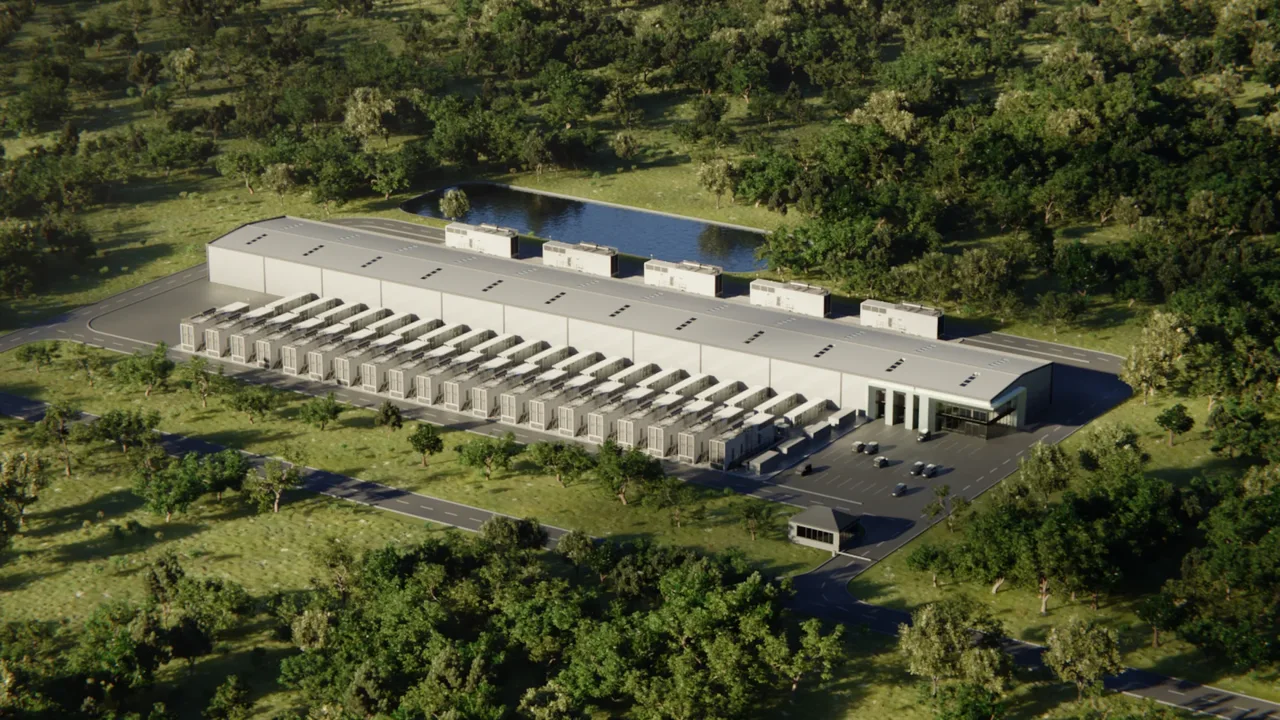
The full campus sits on 30 acres, including landscaping and a sound wall around the facility.
Jobs created
This site will create 20-24 permanent jobs with average salaries ranging from $116K to $180K.
The construction process will bring 300+ more (no more than 100 workers onsite at any time) and we'll actively hire local contractors.
Noise levels
GigaBase data centers are quiet by design. The main sound source is small cooling fans (like those in an air conditioner), and our systems are designed with the fans angled upward to reduce noise.
While the facility will be under legal noise limits, we have also included a permanent sound wall and landscape screening as part of the build to reduce sound even further.
Tax revenue
The campus will generate an estimated $7.2 million in annual tax revenue for Hunt County, all of which will go right back into the community.
Grid improvements
This site runs on existing, unused capacity from Farmers Electric, meaning we are working with power that's already available. Giga is also investing in dedicated feeds and local grid upgrades needed to deliver it.
Frequently Asked Questions
What is being built?
Giga Hunt County is a 30-acre data center campus. The site consists of a pre-engineered metal building housing the computers that train and run AI models, plus the electrical equipment that powers them and the cooling systems that keep them running.
Outside the building, you'll see standard fire lane lighting, landscaping, and a privacy and sound wall.
What is the construction timeline?
Site grading begins in July 2026, and we expect the campus to be up and running by mid-2027. We'll keep the community updated as construction progresses.
Who is paying for electrical infrastructure upgrades?
This site runs on existing, unused capacity from Farmers Electric, power that's already available and not being used. Giga is investing in the dedicated feeds and grid upgrades needed to deliver that power to our site. Giga is also responsible for the costs of extending and upgrading the electrical infrastructure required to serve the facility. Those costs will not be borne by Farmers Electric's other ratepayers.
Will this project impact power reliability for existing members?
This site runs on existing, unused capacity from Farmers Electric, power that's already available and not being used. Giga is investing in the dedicated feeds and grid upgrades needed to deliver that power to our site. Giga is also responsible for the costs of extending and upgrading the electrical infrastructure required to serve the facility. Those costs will not be borne by Farmers Electric's other ratepayers.
What is the total power draw of the facility?
The Giga Hunt County data center has access to 60 megawatts.
Who owns the site?
Giga owns this data center site. We purchased the campus outright, meaning we own it, operate it, and stand behind it.
Will it use our water?
No local water is required for this site's compute operations. Our cooling system is a closed loop that uses a water-glycol mixture, similar to the liquid in a car radiator. It's filled once at the start of the project from water that is trucked in (about 2.5 homes' worth of annual water use) and then continuously recirculated, not drawn from the local supply.
Unlike evaporative data center cooling, once our closed-loop system is filled, the only ongoing water draw is for standard office facilities such as toilets, sinks, and water fountains. This adds up to about as much water as two households use per year.
Where will the site's water come from?
The site’s water for fire safety and employee use will come from one of three sources: a rainwater capture system, water trucked to on-site storage, or upgraded municipal water lines for the area.
Will the site discharge wastewater?
The site will not discharge any industrial wastewater from the cooling systems. We will also not drain any wastewater into the detention pond on the property. The pond is used to manage stormwater runoff only.
How is maintenance handled on the closed-loop fluid?
The system is modular, so individual sections can be isolated and flushed for maintenance without draining the whole loop. Any of our system’s glycol mixture replaced during maintenance is trucked off-site to be disposed of safely, and none of it enters local water or ground.
What decibel levels should neighbors expect to hear from the facility?
When combined with the sound barrier wall, noise at the property line is expected to stay below 50 dB, which is about the same as a running refrigerator. The chillers sit on the ground rather than the roof, muffling the sound and directing it upward rather than outward.
What impact will the generators have on our community?
Generators are for emergencies and maintenance only, kicking in if grid power goes down. Our permit limits them to 100 hours per year, and we expect to run them for fewer than 20 hours, mostly for required testing and maintenance.
Will the data center get priority over homes during a power outage?
No. The facility will not get priority over homes or critical infrastructure. Our project draws from capacity that's already available and unused, so it doesn't come at the expense of the community's power.
Is giga conducting an environmental review?
Giga commissioned third-party environmental studies before deciding to build on site. These studies verified a clean environmental history, confirmed no impact to critical habitat for endangered or threatened species, and confirmed stable ground with no aquatic features or flood hazard. The site plan was custom-designed for this parcel, tailored to the land’s specific conditions.
What is giga doing to combat fire risk at the facility?
We're building a 90,000-gallon water tank on-site, reserved exclusively for fire protection. This tank will not pull from the community's water supply.
For suppression inside the server rooms, our fire engineers are working directly with the Hunt County Fire Marshal to establish the specific methods for this facility. We are also committed to investing in training and assisting with any necessary equipment purchases for local fire departments.
Will it mean months of heavy construction?
We build our data centers in the factory, not in the field, meaning that roughly 90% of the labor happens inside our own factories rather than on site. A conventional stick-built project can put thousands of workers on site for months at a time, but we'll have no more than 100 at any one time. Less on-site labor means less construction time, less noise, and far less traffic for the surrounding roads.
Will construction cause traffic problems?
Trucks will drive about half a mile from the highway to the site, following a designated route to keep heavy traffic off neighborhood roads. We also have a plan to manage dust throughout grading and construction, and we're funding road repairs and improvements so that your local roads end up in as good or better condition than we found them
No more than 100 workers will be on-site at any one time, minimizing construction noise and traffic throughout the build.
How will Giga manage traffic and road conditions during construction?
We're capping active on-site labor at 100 workers at any given time, and we're coordinating with county commissioners to draft a traffic plan. Our trucks will only be traveling half a mile from the highway to the site, and Giga will take financial responsibility for any required road repairs and restoration. Our commitment is to leave the roads in as good or better condition than we found them.