Understanding Step-Up and Step-Down Transformers
Specifying the wrong transformer configuration can blow your entire project budget and timeline. If you don’t understand the type and size of transformer you need for your application, you’ll be stuck waiting months for a replacement while your site sits idle.
Understanding the ins and outs of voltage transformer design and specification can be complicated, but knowing what you need (and how to size it correctly) is the best way to save you from expensive mistakes. With the right guide, you can find the right fit for your build without needing a PhD in electrical engineering.
This guide is for procurement managers, electrical contractors, and construction managers looking to specify the right type of transformer for your next build. We'll explain how step-up and step-down transformers work, when to use each type, and how to avoid specification errors.
.avif)
Step-up vs. step-down transformers: What is the difference?
Let’s start with a simple question: What is a transformer used for? Step-up and step-down transformers are electrical devices that change the voltage level of alternating current (AC) electricity. Their main goal is to adjust voltage levels to allow safe and efficient transmission across power lines or distribution to end users like homes and businesses.
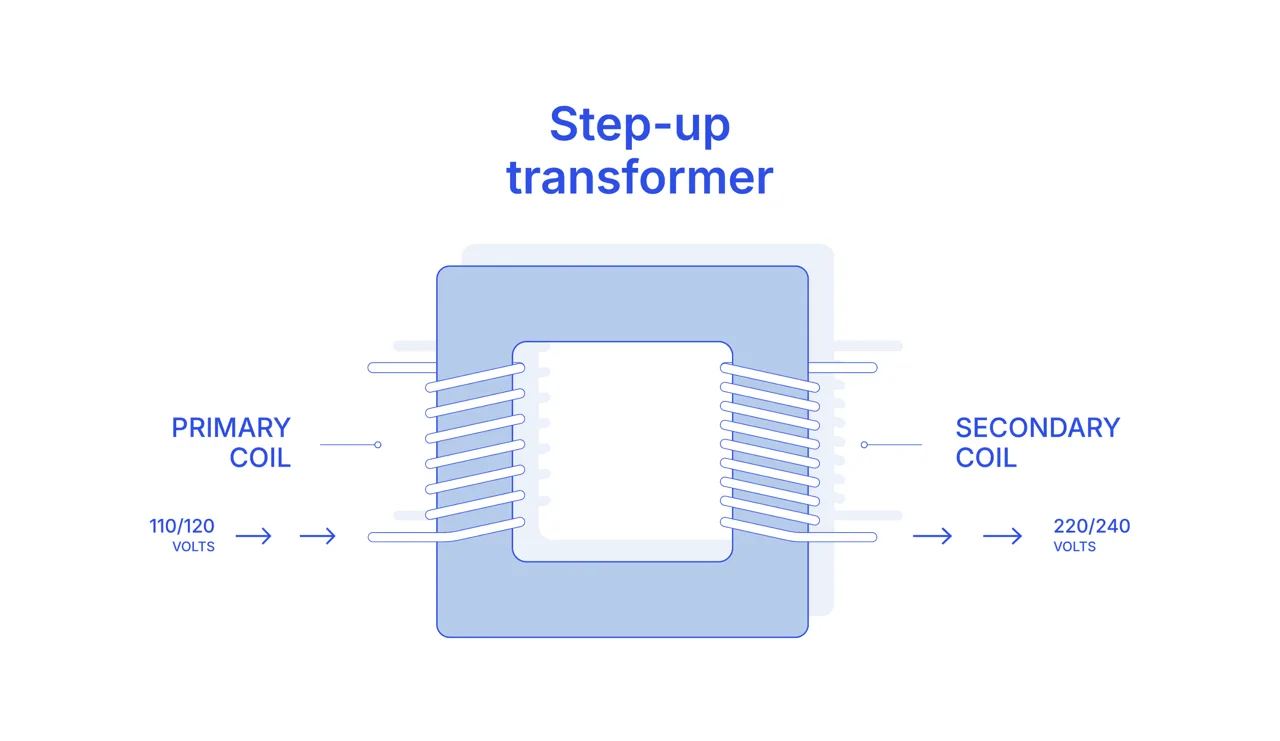
They operate similarly: both use a primary winding (input) and a secondary winding (output) wrapped around a magnetic core. The purpose of these windings is to regulate voltage. The difference between step-up vs. step-down transformers lies in how they alter voltage:
- Step-up transformers increase voltage for long-distance transmission to avoid energy loss.
- Step-down transformers decrease voltage for safe, local distribution.
With this key differentiation and basic understanding of how transformers work in mind, let’s explore each transformer type in more detail.
How step-up transformers work
A step-up transformer increases the voltage from the primary winding (the coil that receives the initial energy) to the secondary winding (the coil where the increased voltage comes out). It does this by having fewer turns in the primary winding than in the secondary, resulting in a higher output voltage. This increase in voltage is critical because it minimizes current in the transmission lines, reducing energy loss and making power transmission more efficient.
Power stations are a good example of this. The electricity generated at a power station typically starts at a low voltage. To transmit it over long distances without significant energy loss, a step-up transformer, usually a specialized step-up device called a GSU transformer, raises the voltage to hundreds of kilovolts (kV). This high voltage helps electricity travel more efficiently across high-voltage power lines to its destination.
Typical Use Cases for Step-Up Transformers
Step-up transformers are essential for power generation and specific industrial settings, helping ensure that electricity can travel long distances efficiently. Here’s a closer look at where they’re used and why:
1. Power generation plants: Power plants, like those using coal, natural gas, hydropower, or nuclear energy, produce electricity at low voltages. However, to send power over long distances, this voltage needs to be increased; otherwise, a lot of electricity would be lost along the way.
A power plant might use a step-up transformer to increase its voltage to around 400,000 volts before sending the electricity out through high-voltage lines. This helps make sure the power reaches homes and businesses far from the plant with minimal loss during transmission.
2. Renewable energy sources: Wind farms and solar plants produce electricity at lower voltages. However, this power must reach the main power grid, often far from the energy source. Higher voltage makes it possible to move this energy over long distances without losing too much of it.
Step-up transformers take the electricity from renewable sources like wind turbines or solar panels and increase the voltage. A wind farm located in a rural area may use step-up transformers to raise the voltage, allowing the electricity to travel efficiently from the wind farm to urban areas that need the power via the main power grid.
3. Industrial facilities requiring high voltage: Some industrial sites, like those in mining or metal processing, need high voltage to power heavy machinery or equipment, allowing them to run more efficiently and with less strain. Step-up transformers increase the available voltage on-site so that factories or processing plants can power large equipment.
This setup helps prevent energy loss and keeps the equipment running smoothly. Steel mills and smelting plants often use step-up transformers to get the higher voltage needed for their processes. For instance, smelting furnaces operate continuously and benefit from higher voltage, which helps save energy and reduce costs.
How Step-Down Transformers Work
Once electricity has traveled a long distance over high-voltage transmission lines, it reaches a substation, where a step-down transformer reduces the voltage. This voltage reduction is essential for both residential and commercial applications since most buildings and devices cannot handle the high voltages used in transmission.
In a step-down transformer, the primary winding has more turns than the secondary winding, which reduces the voltage on the output side. For example, after high-voltage electricity travels from a power plant to a local substation, a step-down transformer lowers the voltage so it can be distributed safely to homes, where devices operate at either 120V or 240V in the US or 230V in many other countries.
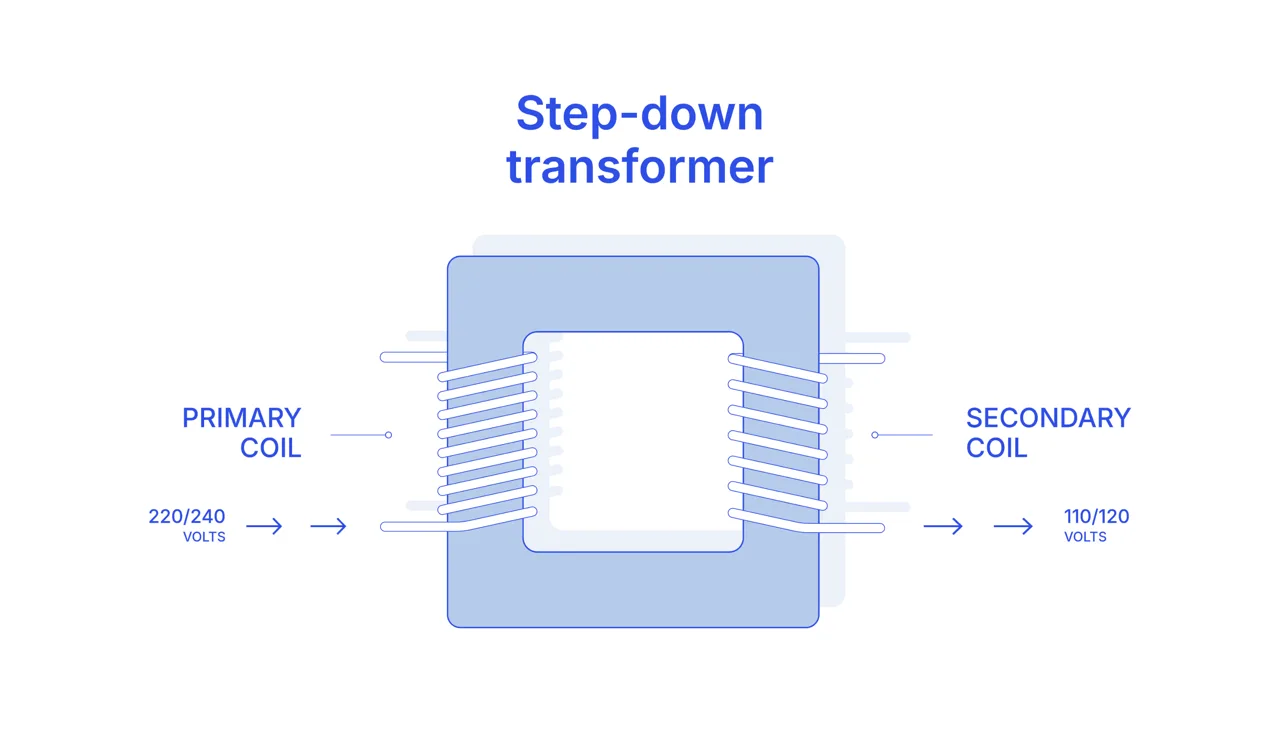
Typical use cases for step-down transformers
Step-down transformers bring high-voltage electricity down to manageable levels for everyday use. Here’s where they are commonly applied:
1. Residential neighborhoods: The electricity that reaches our homes needs to be safe and at a voltage that our devices can handle. However, the electricity coming from power lines is much higher and needs to be reduced. Step-down transformers at neighborhood substations and on utility poles lower the high voltage from power lines to safer levels for home use.
In a typical neighborhood, substations use step-down transformers to bring down the voltage to about 7,200 volts. Then, smaller transformers on utility poles or on the ground in tamper-proof enclosures further lower it to 120/240 split voltage, which is the level required for most household appliances.
2. Commercial and industrial buildings: Businesses and factories often require more power than homes, but they still need it at lower voltages than those in the main power lines. Step-down transformers adjust voltage within industrial or commercial buildings, tailoring it to the specific requirements of each piece of equipment. Factories and hospitals often use these transformers to provide the right voltage for machines like hospital imaging devices or factory robotics. This control prevents damage to sensitive equipment and ensures steady performance.
3. Data center facilities: Data centers, from traditional colocation sites to AI hyperscalers running high-density GPU clusters, receive power from utilities at medium voltages, typically 12.47kV or 13.8kV. However, the servers, cooling systems, and compute equipment inside operate at much lower voltages. Step-down transformers reduce the utility voltage for safe distribution throughout the facility. A typical data center uses multiple padmount transformers to provide redundant power paths so the server equipment receives stable, reliable power at the correct voltage.
4. Bitcoin mining sites: Mining operations receive high-voltage electricity from utility lines, but mining containers and equipment require lower voltages to operate safely. Step-down transformers for Bitcoin mining convert utility power down to 480V for distribution to mining containers. A 10 MW mining site might use two large step-down transformers, each serving multiple mining containers.
5. Manufacturing and industrial plants: Large factories and processing facilities receive power from utilities at voltages that are too high for their equipment to use directly. Step-down transformers reduce this voltage to levels appropriate for production machinery, conveyor systems, and facility operations. Multiple transformers throughout the plant serve different production areas, allowing factories to expand capacity over time by adding transformers as new equipment comes online.
Key differences between step-up and step-down transformers
Next, let’s walk through a quick-reference comparison guide to better illustrate the differences between step-up and step-down transformers.
1. Voltage transformation
Step-up transformers increase the voltage, which makes them ideal for long-distance transmission. By increasing the voltage, these transformers enable electricity to travel over long distances through power lines with minimal energy loss. A step-up transformer in a power plant might boost the voltage from thousands of volts to hundreds of thousands of volts, ensuring efficient transmission across regional grids.
On the other hand, step-down transformers reduce the voltage, making electricity safe and usable in homes and businesses. By decreasing the voltage, step-down transformers deliver power at levels that meet specific local needs. For example, a transformer near residential areas may reduce high-voltage transmission lines to a lower, safer level for household devices.
2. Current transformation
In a step-up transformer, while the voltage increases, the current (flow of electric charge through a conductor, typically measured in amperes) decreases. This inverse relationship aligns with the law of conservation of energy, which states that energy cannot be created or destroyed, only transformed. Lower current levels mean less heat loss in power lines, improving efficiency and reducing overall transmission costs.
For step-down transformers, the opposite occurs: decreasing the voltage increases the current. This higher current allows for the power to be safely distributed and utilized at lower voltage levels, making it ideal for everyday applications. Higher current levels after stepping down the voltage make sure that the end-users receive sufficient power at a safe voltage level.
3. Winding ratio
Transformers rely on the winding ratio — the number of coils in the primary versus the secondary winding — to determine their function. This ratio directly affects whether a transformer will step voltage up or down.
Step-up transformers have fewer turns in the primary winding compared to the secondary winding. This configuration ensures that the voltage increases as electricity flows from the primary to the secondary winding.
In contrast, step-down transformers have more turns in the primary winding than in the secondary winding. This setup decreases the voltage as it moves from the primary to the secondary side.
Factors to consider when choosing between step-up and step-down transformers
The number one consideration when choosing between step-up and step-down padmount transformers is your voltage and current requirements. If you need to increase voltage before transmitting it over a long distance, you’ll need a step-up transformer. If you’re looking to reduce high-voltage electricity to safer, usable levels for homes, businesses, and industries, you’re looking for a voltage step-down transformer.
Costs and maintenance can make a big difference, too. Step-up transformers typically come with higher upfront costs and may need specialized maintenance. On the flip side, step-down transformers are typically less expensive. They are simpler to maintain, but they still need regular check-ups to keep everything running smoothly. Without maintenance, they could face some problems like insulation issues or overheating, which can lead to unexpected costs or downtime.
Lead times and delivery: What to expect
Whether you’re specifying a step-up or step-down transformer, you need to have a firm grasp on industry lead times if you want to avoid creating a bottleneck in your build. Let’s take a look at the realities of what you can expect.
On average, transformer lead times can be brutal. Material shortages, overwhelmed manufacturing capacity, and surging demand have created a perfect storm of delays. Legacy manufacturers often quote up to 26 weeks for standard distribution transformers, and that's for off-the-shelf, catalog-spec units. If you need custom transformers with specialized voltages or utility-specific standards, you're looking at a lead time of 40+ weeks.
If you need a step-up or step-down transformer on a reasonable timeline, your best bet is to work with Giga. We offer 3-phase and single-phase padmount transformers, substations, switchboards and more, all built to order with faster-than-average lead times.
How are we so much faster than the industry standard without sacrificing quality? Simple: American engineering combined with an optimized global supply chain. We’re not dependent on third-party vendors who add lag time at every step. We own the entire process, so when we quote a lead time, we hit it.
If you’re ready to move fast now that you’ve identified the type of transformer you need for your build, contact our team for a lead time estimate.
Understanding the differences between step-up and step-down transformers
When it comes to selecting the right transformer for your build, precision is everything. Understanding the differences between step-up and step-down transformers can feel overwhelming, but it boils down to one key difference:
- Step-up transformers increase voltage for efficient transmission.
- Step-down transformers reduce voltage for safe use.
Following the guidance in this post, you should be able to identify which transformer type fits your data center, mining site, or industrial facility. But identifying the right type is only half the equation.
If you want to stick to your timelines and budget, you need to work with the right supplier. Giga strives to cut industry-standard lead times in half. We help you coordinate with utilities, size equipment correctly, and provide engineering support from specification through commissioning.
Ready to spec transformers that actually arrive when promised? Build a quote to get real lead times, or contact our team to discuss your project requirements. We'll help you get it right the first time.