During an emergency shutdown, your electrical switchboard needs more than passive protection. Your standard breakers kill power during a fault, but what if you need to kill power right now, before something breaks?
Switchboard safety features aren’t the flashiest part of any facility, but they are critical to running a safe, functional operation. If you want to be able to enable remote shutdowns, protect against voltage spikes, monitor power quality, and integrate with facility safety systems, you need more than just standard breakers. You’ll need to explore shunt trip breakers and other add-ons.
This post breaks down how shunt trip breakers work and covers other essential switchboard components. We'll walk through shunt trips, surge protection, power metering, ground fault detection, and communication interfaces.
.avif)
What is a shunt trip breaker?
A shunt trip breaker is an electromechanical device that gives you remote or automatic control over your circuit breaker. Your shunt trip breaker acts as a kill switch that can be triggered from a distance, integrated with a device like an emergency power off button, feeder protection relay, or programmed into other automated safety systems.
Let’s take a closer look at the differences between a shunt trip breaker and a standard one.
- Standard breakers provide passive protection. They react when something goes wrong, like an overcurrent condition, a short circuit, or an overload.
- Shunt trip breakers provide active protection. They trip on command from an external signal, whether that's someone hitting an emergency stop button, a fire alarm contact closing, or a PLC output energizing. They give you control.
This distinction matters because modern industrial and data facilities can't always wait for a fault to happen. Sometimes you need to kill power immediately and deliberately. For some facilities, they’re required by code, making them a mandatory part of your build.
If your switchboard is protecting equipment that can't afford to wait for a fault or if your facility requires deliberate, immediate power shutoff in specific scenarios, you may need a shunt trip breaker.
How a shunt trip breaker actually works
A shunt trip breaker’s mechanism is straightforward. A solenoid coil sits inside the design, waiting for a signal. When the signal hits the coil, it creates a magnetic field that mechanically forces the breaker contacts open. Generally, it takes between 50 and 150 milliseconds to trip a shunt trip breaker, which is critical when dealing with emergency shutdowns.
To make this work, you need four essential components working together:
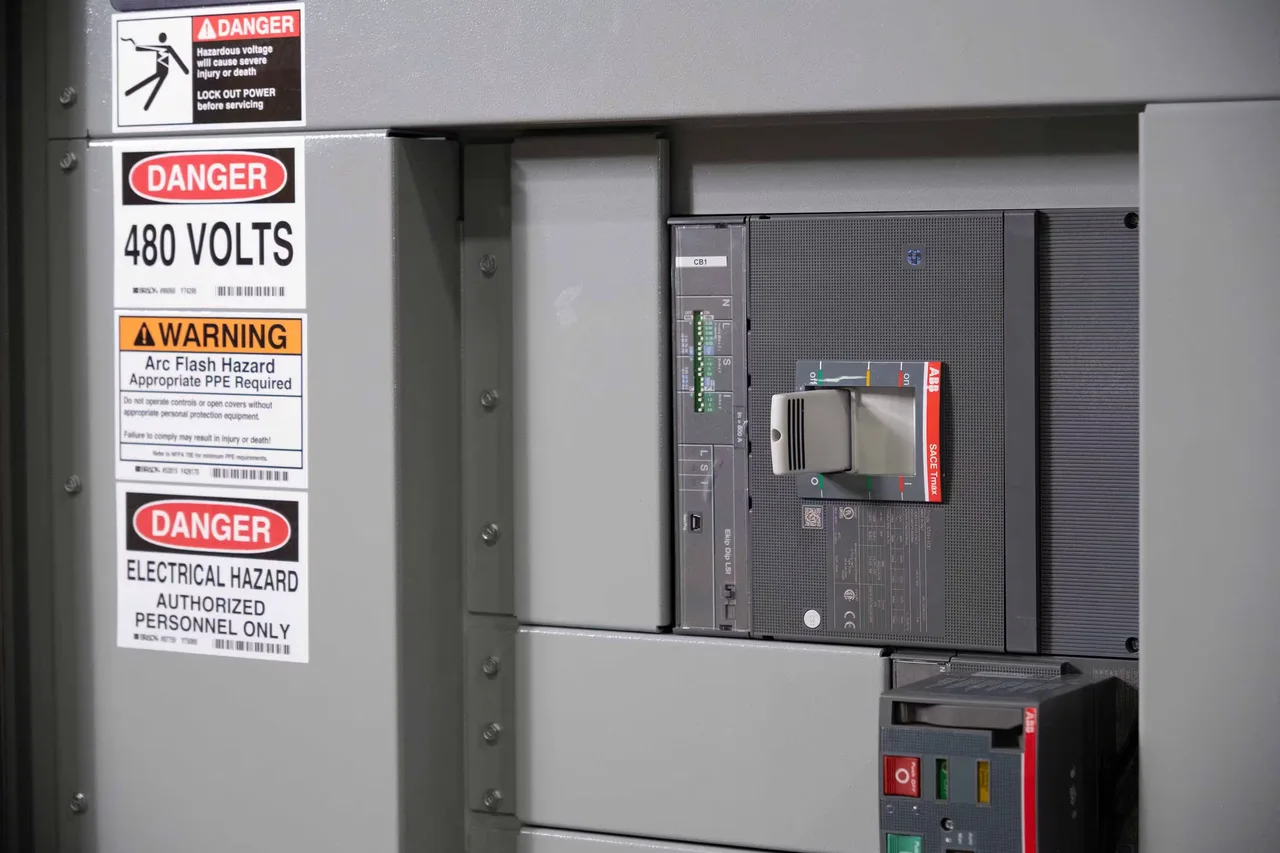
- The circuit breaker: Not every breaker can accept a shunt trip accessory. The breaker has to be designed with the internal linkages and mounting provisions to accommodate it.
- The shunt trip coil: Be sure to match your coil to your control system voltage, otherwise it won't work or will burn out immediately.
- Control power source: This is separate from your main circuit power. It's a dedicated supply, often from a control transformer or PLC power supply, that energizes the coil when needed.
- Initiating device: This is what triggers the trip. It could be an emergency stop button, a fire alarm contact, a PLC output, or any other normally-open contact that closes when you need to kill power.
Remember that shunt trips are designed for a brief jolt of voltage only. If you leave continuous power on that coil, you'll burn it out in minutes. Proper wiring always uses normally-open contacts that close only during the trip event, then open again once the signal clears. It's a quick hit, not a sustained hold.
One more point of confusion worth clearing up is the difference between shunt trips and undervoltage releases.
An undervoltage release (UVR) requires continuous voltage to keep the breaker closed. If that voltage drops or disappears, the breaker trips. It's the opposite function of a shunt trip. A UVR trips when power is lost or when voltage runs at a threshold lower than the required amount for a set amount of time, while a shunt trip trips when power is applied.
Related read: Key Considerations When Specifying An Electrical Switchboard for a Project
When to specify a shunt trip for your switchboard
First and foremost, ask yourself whether your application requires a shunt trip. A shunt trip isn't a universal add-on. You need one when:
- Fire suppression integration is mandatory
- Remote emergency shutdown is required
- You're running automated safety interlocks via PLC
- Critical infrastructure demands rapid shutdown protocols
If your project checks any of those boxes, spec your shunt trip using the following four-step process.
Step 1: Match your control system voltage
Identify what voltage your control system operates on, then select the corresponding shunt trip coil:
A mismatched voltage either won't generate enough magnetic force to trip the breaker, or it'll immediately fry the coil. Neither scenario is fixable in the field without ordering new parts and waiting.
Step 2: Confirm breaker compatibility
The shunt trip accessory has to be compatible with your breaker manufacturer. At Giga, we standardize ABB breakers for our switchboards, but we can accommodate alternatives if your project requires it.
Step 3: Plan for Physical Space
Shunt trips and their associated wiring take up room inside the switchboard cabinet. Account for this during the layout phase, not after the cabinet is built. Bring it up during your technical review so the enclosure is sized correctly from the start.
Step 4: Size Your Control Circuit Fusing
The control wiring feeding that shunt trip coil needs its own overcurrent protection. This protects against shorts without nuisance tripping on the coil's inrush current. Be sure not to skip this step, as it’s critical for safety.
Other essential switchboard add-ons
Shunt trips are the focus of this post, but they’re not the only add-on you may want to consider for your switchboard. A well-spec’d switchboard includes other components that help protect your equipment, give you access to real-time data, and ensure your system is up to code.
Surge protection devices (SPDs)
SPDs protect your downstream equipment from voltage spikes due to lightning strikes, utility switching events, or other overvoltage events. The SPD diverts that excess voltage safely to the ground before it reaches and damages your equipment.
You should specify surge protection for facilities with sensitive electronics that can't tolerate voltage transients, areas prone to lightning strikes where utility surges are common, and data centers or computing infrastructure where even a brief spike can cause expensive downtime or equipment damage.
Power metering and monitoring
Power metering gives you real-time visibility into electrical consumption and power quality. The types available range from basic kWh meters that simply track energy consumption, to advanced power quality meters that monitor voltage, current, power factor, and harmonic distortion. These can integrate with HMI screens mounted on the switchboard or feed data directly into your SCADA system for remote monitoring.
Metering helps you identify inefficiencies and potential issues before they turn into failures. It supports demand response programs, which are directly relevant if you're participating in a demand response program to monetize flexible load.
It also ensures compliance with utility requirements, especially for larger installations where the utility wants verification of your load profile.
Ground fault detection/protection
Ground fault protection detects current leakage and, when current starts flowing where it shouldn't, your ground fault devices sense it and either trip the circuit or sound an alarm.
This add-on is particularly important for outdoor or NEMA 3R rated switchboards exposed to the elements, wet or corrosive environments where insulation can degrade, and healthcare or other critical facilities.
Ground fault protection is different from standard overcurrent protection. A breaker protects against overloads and short circuits on the main conductors. Ground fault devices protect against current leaking outside the intended circuit, which is a completely different failure mode.
Communication and control interfaces
Modern switchboards are more than on-off switches. With communication and control interfaces, you can let your switchboard communicate with the rest of your facility.
Contact outputs provide breaker status monitoring so your control system knows whether a breaker is open, closed, or tripped. Remote control capabilities via Modbus, BACnet, or proprietary protocols allow you to operate breakers from a central control room or integrate them into automated sequences. And full integration with building management systems (BMS) means your electrical distribution becomes part of a coordinated facility control strategy.
These features are increasingly standard in modern automated facilities. If you're building for the future, plan for connectivity now rather than retrofitting it later.
Current transformers (CTs) and potential transformers (PTs)
Current transformers and potential transformers step down current and voltage to safe, measurable levels. Your main bus might be carrying 2000 amps at 480 volts, but your metering equipment operates at 5 amps and 120 volts. CTs and PTs make that conversion safely.
CTs are sized based on your main bus amperage, and both CTs and PTs are often bundled with power metering packages as a complete monitoring solution. If you're specifying power metering, you're specifying CTs and PTs.
How add-ons impact switchboard lead time and cost
One common misconception is that it’s easy to add on features like the ones we’ve discussed in this post after manufacturing starts. Unfortunately, that is not the case. Every change or addition ripples through the design, the bill of materials, the cabinet layout, and the testing protocol.
When you request to add a shunt trip or power metering after the original switchboard spec, expect higher costs and longer lead times. These changes require re-engineering, new components, and changes to cabinets already in production.
If you want to keep your costs predictable and your lead times as short as possible, define all your requirements during the technical review phase, before you submit your PO. When you spec all the right equipment from day one, your manufacturer can quote more accurately and build the right thing on the right lead time.
At Giga, we build switchboards with modular customization in mind. That means you can get shunt trips, surge protection, power metering, and other add-ons without blowing up your timeline as long as you specify them upfront.
Choosing the right shunt trip breaker and add-ons for your application
Shunt trips provide critical safety features for the facilities that require them, but they’re only one piece of the puzzle. You need the right equipment, add-ons, and monitoring features to run a safe, efficient operation.
The key is specifying everything you need upfront. When you define your requirements during the technical review phase, you get accurate costing, realistic timelines, proper integration, and complete factory testing.
At Giga, we run technical review calls before every PO to validate requirements and make sure nothing gets missed. Our in-house engineering team has seen dozens of complex applications, and we know what works. And every switchboard we build is manufactured and tested in California to UL 891 standards.
Planning a switchboard project? Our engineering team can help you specify the right combination of shunt trips, protection devices, and monitoring equipment for your application. Build a quote or contact our team to discuss your specific requirements.
.avif?w=1280)