

Every day a GPU cluster is sitting idle, waiting for your facility to go live, you’re losing money. If you’re racing to deploy compute power, you need your AI data center design to accelerate your time to power, rather than serving as a bottleneck.
You already know what you want to build: you just need to know what design choices will get you to RFS the fastest.
This post walks through the decisions that can help you get an AI data center built and running within nine months instead of several years. We’ll cover power architecture, cooling topology, and the prefabricated build approach that can speed up your schedule.
Reach out to our team to see how we can stand up your new data center in nine months.
The main constraint behind AI data center design
The GPU bottleneck is starting to loosen, but that opens builders up to a new problem: most of those GPUs have nowhere to go.
The constraint on AI compute has shifted from silicon to infrastructure. The traditional data center development process wasn’t built for this volume and urgency. The conventional path tends to take 18 to 36 months, which is nowhere near the speed AI site operators need to move.
Time-to-compute is the number one criterion for hyperscalers, GPU cloud providers, and AI startups alike. You want the right equipment, and you want it fast, so you can reduce your time to RFS, or ready for service.
Read more: Data center construction guide: Costs, timelines, and equipment
RFS is the moment the facility is actually operational and compute goes live. It's the only milestone that matters commercially, and it's the one most development timelines are worst at predicting.
During your design process, you’ll run up against a few elements that can be tricky to manage.
- Density: Higher rack densities require more complex power and cooling systems, which can add months to a build if they aren't designed for rapid deployment from the start.
- Cooling complexity: Liquid cooling is crucial for AI-class facilities, and integrating it into your build can complicate and delay your site, especially if you’re using a traditional construction approach.
- Quality: You want things fast, but they still need to be built right. If you rush to hit an aggressive RFS date, you can end up with commissioning failures and rework.
These aren’t areas you can afford to sacrifice in favor of a faster timeline. Instead, you need to use an AI data center design and construction methodology that gives you the density, cooling, and quality you need without forcing you to wait years to get online.
Site selection
You need available megawatts and a cooperative utility before you can start your AI data center build. Power availability is one of the most common reasons AI data center projects stall in the early stages. Interconnection queues can add a year or more to your timeline, so it’s key to start this process early.
Site selection and power origination should run in parallel with or ahead of facility design. Waiting until the design is finished before starting power sourcing is how 12-month projects become 30-month projects.
The fastest path to RFS is energized land with an existing utility relationship. If a developer already operates load on a site and the utility knows them as a reliable customer, pivoting that capacity to AI compute is dramatically faster than starting from scratch with no interconnection agreement.
Did you know? Giga Energy has a portfolio of powered land available for buyers looking to build AI data centers. Contact our sites team for more information.
A few other location-based factors to keep in mind:
- City boundaries: Sites outside city limits typically face simpler permitting. Inside a municipality, you're navigating zoning, building codes, and local review processes that add time.
- Existing grid infrastructure: If your site will need a new substation, it can add a year or more to your timeline.
- Utility disposition: If the local utility already has the capacity and motivation to serve your load, it will be much easier to navigate that relationship than trying to negotiate from scratch.
Power architecture
Traditional data centers designed their electrical systems from the utility connection down. Substation to switchboard to panel to rack. The rack was almost an afterthought, with a modest 8–10 kW load at the end of the line.
AI flips that.
A single GPU rack running current-generation chips like the GB300 can draw 165 kW, which means your electrical design needs to start at the rack and work backward. Consider what each rack needs, then let that knowledge guide your low- and medium-voltage infrastructure choices.
You’ll also want to consider redundancy at this stage. You’ll want N+1 redundancy, meaning you have one additional unit of each piece of critical infrastructure. This approach helps you protect your uptime without overbuilding the design.
Power architecture is the bottleneck for most current AI builds due to all the long-lead equipment involved at this stage. Industry-average lead times for custom transformers and substations can easily stretch over a year.
The design decision you’ll make related to power architecture that can compress those timelines is choosing the right partner. Giga Energy uses a pod-based build structure, and we own our entire supply chain. That means we manufacture and test all our American-engineered equipment in our own facilities and ship it out in ready-to-install pods that require no on-site assembly.
Cooling topology
Liquid cooling is the baseline for any AI-class facility, so you need to be sure to plan for direct-to-chip cooling via CDUs in the design phase of your AI data center build.
The design choice that matters most for your timeline is where the cooling system gets built. In a traditional approach, cooling is designed and installed as a building system and is piped, plumbed, and commissioned on-site. For AI-class density, that introduces weeks or months of on-site coordination and rework.
A faster approach is to integrate CDUs and fan wall units directly into the pod structure we discussed in the previous section. This way, the entire cooling loop can be manufactured, filled, flushed, and tested at the factory before it ships. When the pod arrives on site, the primary cooling system just needs to get hooked up to the facility's water loop rather than needing to be built from scratch.
Pre-fabricated design
The traditional approach to AI data center design is site construction. In this approach, you pour a foundation, erect steel, run conduit, pull wire, install mechanical systems, and commission everything in sequence on-site over 18 months or more.
Pre-fabricated design offers an alternative that can significantly speed up your RFS timeline.
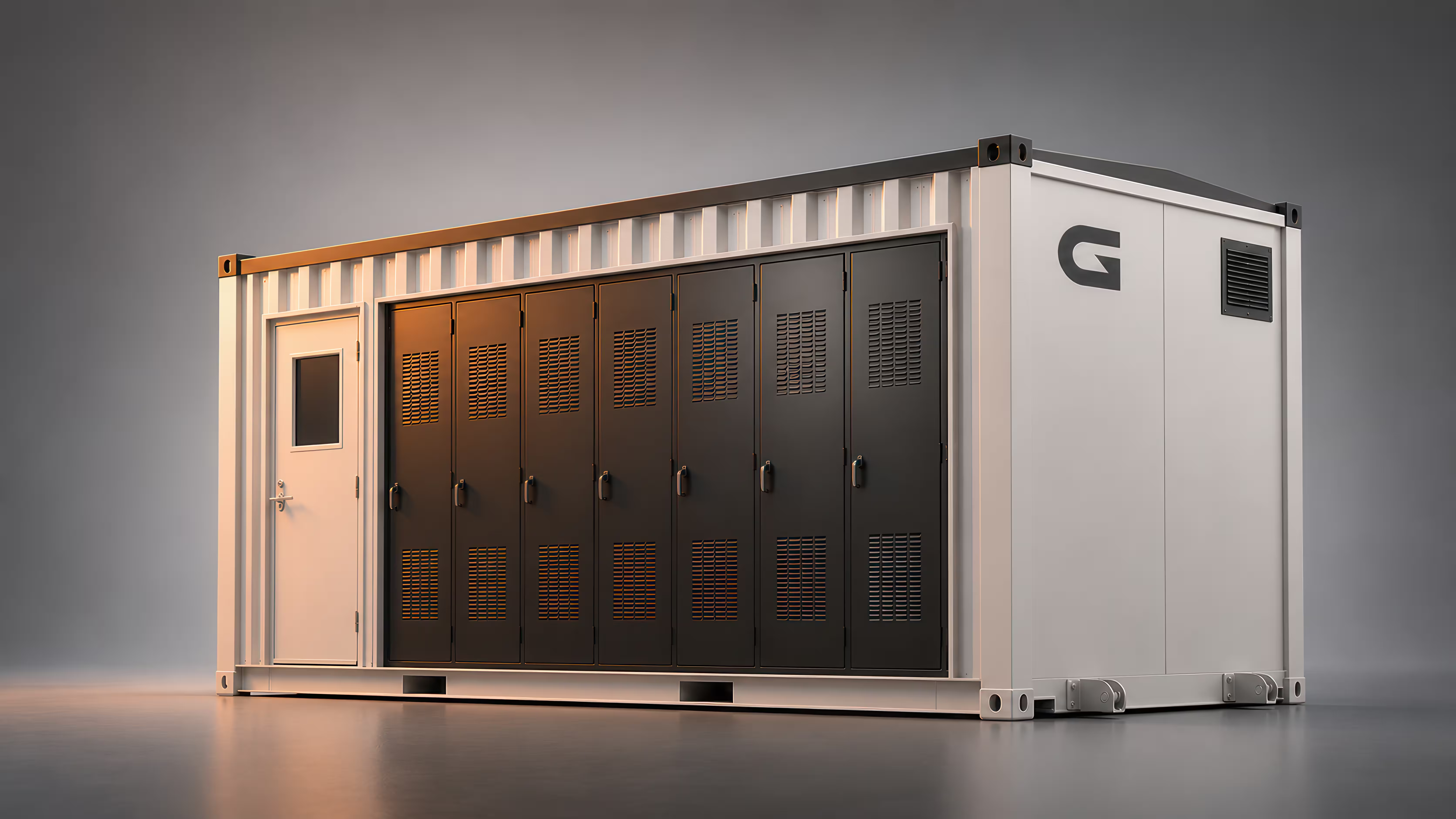
Giga manufactures data center infrastructure with pre-fabricated pods that we build and test in our manufacturing facilities, then simply install those pods on-site.
Each pod is a self-contained unit, roughly 45 feet long, that ships with power distribution and cooling infrastructure already installed and tested. Compute racks roll into the pod on-site once it's connected, because the pod is infrastructure, not IT, so it can arrive ready to house whatever hardware your data center needs.
A traditional build at this scale might require 400 to 500 electricians on-site. A pod-based approach can bring that down to 30 to 40 over three to four months. In a market where skilled electrical trades are scarce, that's the difference between a project that staffs up on schedule and one that doesn't.
The net result of our pre-fabricated pod approach is that your contract signature to RFS is measured in months instead of years for a new data center build.
The AI data center design that gets you to RFS the fastest
The companies getting AI compute online fastest aren't drawing bigger blueprints. They're working with partners who manufacture data centers rather than construct them, who own their equipment supply chain, and who show up with energized sites and utility relationships already in place.
Ultimately, the key to AI data center design is integration. Having one point of contact for your equipment manufacturer, design engineer, and general contractor means you don’t have to wait for multiple vendors to play phone tag, passing your project along at every stage.
If your RFS timeline matters, your partner needs to control the full stack from power origination through pod delivery. Book a call with our sites team to see how Giga gets AI data centers from contract to RFS in months, not years.
.avif)


.avif)