
Data center electrical failures don't announce themselves ahead of time. One overheated transformer, miscoordinated breaker, or grounding fault, and racks worth millions in compute capacity go dark. The only way to avoid these issues is to set yourself up for success with standards upfront.
That’s where Division 26 comes into play.
Division 26 specifications define how transformers get sized, how switchgear gets rated, how grounding systems get tested. But beyond the bureaucratic definitions, what does the Division 26 framework mean, and how does it help your data center?
This post covers what Division 26 requires and how you can specify compliant equipment that keeps your data center running smoothly.
.avif)
Understanding Division 26 electrical standards for data centers
Before we explore the equipment specifications related to Division 26, let’s discuss Division 26 electrical standards more broadly. These standards are central to every commercial construction project. Division 26 covers everything from conduit to transformers and switchgear.
It’s useful to think of Division 26 as a rulebook or guide to help prevent your electrical infrastructure from failing. It’s a complete framework for building electrical systems in ways that work safely in real-world conditions.
Division 26 specifications define the materials, methods, and standards that electrical contractors must follow. It references the standards that govern electrical and transformer safety and performance:
- NEC/NFPA 70 for code compliance
- NEMA for equipment ratings and enclosures
- UL for product testing and listing
- IEEE for power system design
- ASTM for materials
When these standards conflict with manufacturer claims or contractor preferences, Division 26 specifications make clear which rules apply.
When you’re building a site with five different vendors, where none of them are talking to each other, and each points fingers at the others when Division 26 violations surface during commissioning, it’s hard to get anything done right. That's why, at Giga, we vertically integrate all our processes. One partner from design through delivery means no coordination failures, no finger-pointing, just compliant infrastructure on time.
With this context in mind, let’s walk through what Division 26 actually requires for data centers that stay online.
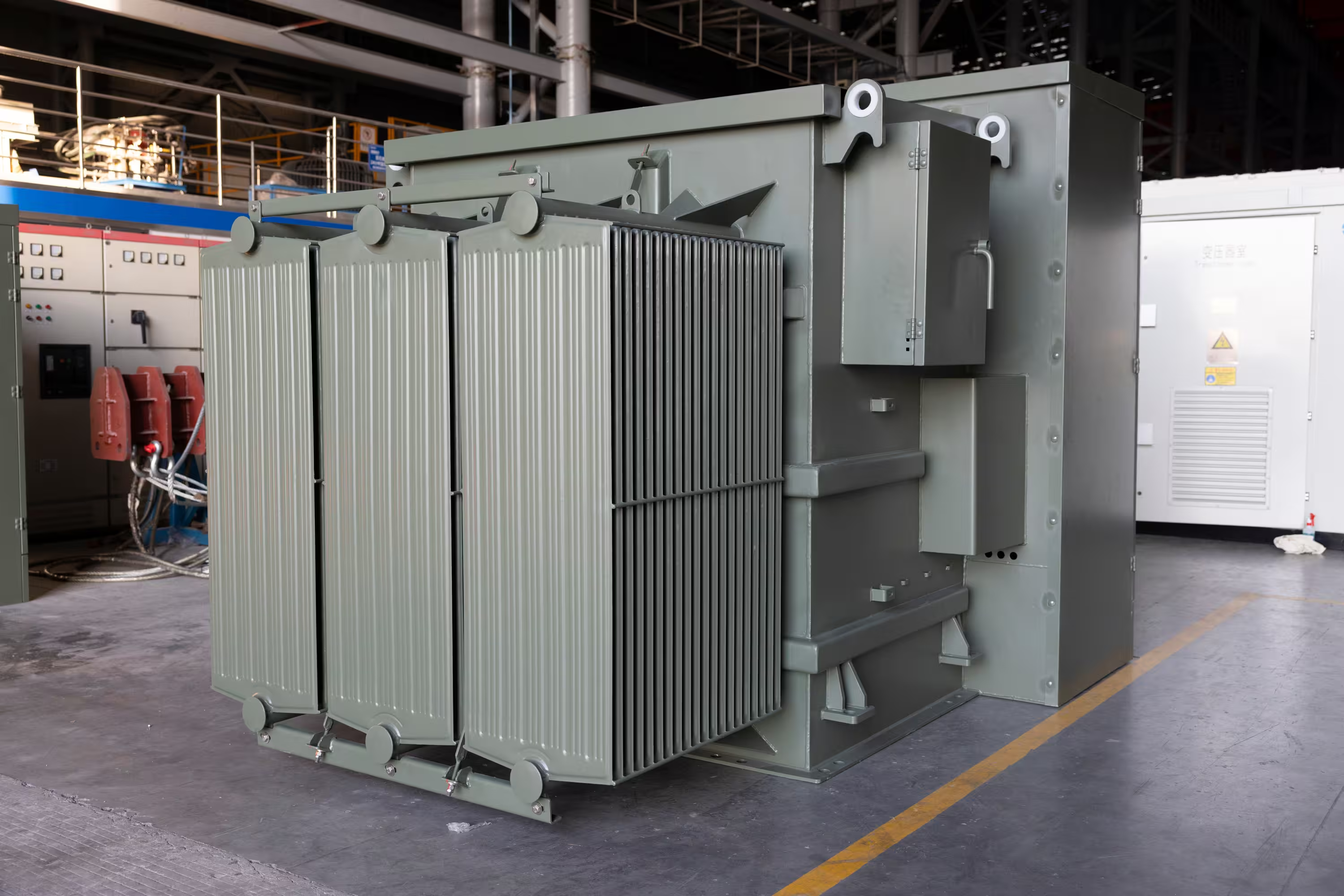
Transformer specifications under Division 26
Division 26 transformer specifications start with energy efficiency requirements, specifically ASHRAE 90.1 and the Energy Policy Act of 2005. Let’s discuss each in a bit more detail:
- ASHRAE 90.1: The commercial building energy efficiency standard that sets minimum performance requirements for transformers, lighting, HVAC, and building envelope. It's updated every three years, and Division 26 specifications reference it to ensure electrical equipment doesn't waste energy.
- Energy Policy Act of 2005: Federal legislation that established mandatory efficiency standards for low-voltage dry-type transformers. If your transformer doesn't meet EPAct 2005 requirements, it's illegal to install in most applications.
Modern data centers also need k-rated transformers designed for non-sinusoidal loads. Standard transformers assume clean sinusoidal power, meaning they’ll overheat if you feed them the harmonic-rich current from switched-mode power supplies and VFDs.
NEMA ST-20 and ANSI/IEEE C57.12.01 establish baseline standards for transformer performance, but Division 26 can sometimes go even further. Sound level requirements typically mandate 3dB below NEMA ST-20 limits.
Next, consider temperature ratings. Division 26 specs typically define this through temperature rise rather than insulation class directly.
For data centers, specifying an 80°C rise transformer gives you the headroom you need as ambient temperatures rise and ventilation systems work hard. This applies specifically to pad-mounted, liquid-filled transformers (covered under Division 26 Section 26 12 19) — not dry-type units, which are typically rated for a 150°C rise. The lower temperature rise isn't a Division 26 mandate, but in a facility where cooling hiccups are a real operational risk, it's worth calling out in your spec.
Finally, Division 26 has requirements related to sizing methodology. Division 26 calls for calculating demand load per NEC, then adding 30% spare capacity.
Switchgear and switchboard requirements
Switchgear requirements begin with the basics of UL listing (UL 891) and NEMA compliance, but Division 26 goes far deeper, considering interrupt and short-circuit current withstand ratings.
Your enclosure selection depends on your facility’s environment.
- NEMA 1 works for clean, dry electrical rooms.
- NEMA 3R handles outdoor installations where rain is the enemy.
- NEMA 4X stainless steel goes anywhere corrosive, like coastal sites, chemical facilities, or anywhere you can't trust the environment.
Division 26 often restricts top-entry in medium-voltage switchgear installed in wet or outdoor environments because water follows conduit paths downward, and wet MV connections are dangerous. For NEMA 3R enclosures, bottom entry is typically preferred or required. Top entry may be permitted in dry indoor applications, but if your build is exposed to weather, expect specs to mandate bottom entry with appropriate sealing.
Grounding and bonding systems
Next, you need to specify your grounding and bonding systems. IEEE 142 and NFPA 70 establish the grounding requirements used by Division 26. Per these requirements, maximum ground resistance specifications typically cap at 10 ohms or less; the lower the better.
Grounding electrode systems for data centers go beyond the minimum single ground rod requirement in the code. Multiple rods, ground rings, concrete-encased electrodes, and structural steel connections create a low-impedance path to earth. Equipment grounding conductors must run with every circuit and must be sized per NEC tables to provide the right fault current return path to trip specified overcurrent devices.
Finally, consider NETA standards for testing and documentation requirements. You must measure and record ground resistance and prove the system works before you’ll be able to energize your site.
Testing, commissioning, and documentation requirements
Division 26 requires testing at multiple stages to prove electrical systems work before they carry critical loads.
- Factory acceptance testing: This testing catches problems before the equipment ships. Factory acceptance testing typically checks for transformer no-load loss, impedance, switchgear breaker operation, and more.
- Field acceptance testing: These tests verify everything works under actual site conditions. NETA-certified firms verify insulation resistance, protective devices, ground systems, and more.
- Infrared thermographic inspection: This inspection happens six months post-occupancy when the facility runs under real load. Loose connections and undersized conductors show up as hot spots before they fail, and this inspection catches those potential failure points early.
- Power system studies: Studies like short-circuit, coordination, and arc flash analyses help you keep your site safe and tell maintenance crews what PPE they need to work safely on your equipment.
Division 26 treats testing and documentation as critical deliverables, not afterthoughts. As-built drawings and O&M manuals document what was actually built, so operators can maintain it. Every requirement exists because electrical systems that look good on paper still need to prove they work in reality.
Read more: How Giga builds AI-ready data centers in 6-8 months
Power quality and monitoring
Modern electronic loads generate harmonic currents that overheat neutral conductors, trip breakers for no apparent reason, and age equipment faster than continuous loads. Division 26 harmonic analysis requirements identify these issues before you energize.
Power factor correction targets 95% to minimize utility demand charges and reduce distribution system losses. You achieve this through capacitors sized and located correctly. Instead of a single bank at the service entrance, you need distributed correction that accounts for actual load profiles.
Electrical monitoring at main breakers tracks everything that matters: three-phase voltage (L-L and L-G), amperes on each phase, kW, kVAR, kVA, kWh, kVARh, harmonics, relay status, and breaker position. This data integrates with SCADA and building management systems for real-time visibility. You see load trends developing before they cause problems. You verify your demand diversity assumptions against actual consumption. You optimize operations based on reality, not guesswork.
Division 26 specifications increasingly mandate Modbus TCP/IP communication for monitoring data. The goal is, ultimately, to know what your electrical systems are doing every moment so you can keep them running.
How Division 26 standards apply to modern data center infrastructure
AI and hyperscale data centers can be tricky because they break the assumptions baked into traditional Division 26 specifications. A typical commercial office building might pull 10-20 watts per square foot, whereas modern AI training clusters can hit up to 1000+ watts per square foot.
High-density loads force transformer-sizing decisions that most electrical engineers never face. You can't apply standard demand factors when every rack is continuously at full load. Division 26 calls for 30% spare capacity above calculated demand, but AI facilities often need to bake in even more of a buffer to accommodate rapid growth.
Division 26 principles still apply: size the overcurrent protection correctly, coordinate selective tripping, and prove that your alternate feed can handle the transferred load during failures. But modern data centers face infrastructure challenges that stretch Division 26 beyond its original scope:
- Renewable tie-ins introduce voltage fluctuations and reverse power flow that require careful grounding coordination
- Mechanical system integration creates harmonic loads when chillers and cooling fans track IT demand in real time
- Staged deployment means making sure that Phase 3 switchgear coordinates with Phase 1 panels installed 18 months earlier
Each of these makes it more complicated to comply with Division 26. Your documentation requirements get more tangled, protection settings change between configurations, and you need testing to verify every stage of your growing build.
Ensuring Division 26 compliance with Giga Energy
Division 26 compliance is the foundation of reliable data center infrastructure. Every transformer rating, every breaker coordination curve, and every grounding electrode matters when you lose real money for every minute of downtime.
The legacy approach to data center site construction fragments this work across five to seven vendors, each responsible for one piece, none of them accountable for how it all works together. That's where projects stall, where compliance gaps appear, and where builds slip weeks or months off-schedule.
At Giga, we vertically integrate because it's the only way to deliver speed without compromise. Our motto is, “one partner from spec to site.” We manufacture the transformers and switchgear. We originate the sites and optimize them for the power markets. When Division 26 requires factory testing, coordination studies, or NETA certification, we own those deliverables and offer our expertise.
Ready to build Division 26-compliant infrastructure on a timeline that works? Build a quote for your project or get in touch with the Giga team today and see how vertical integration changes the math on delivery speed and quality.


.avif)