Fusing options for padmount transformers
A blown fuse at the wrong time can cost you thousands in lost revenue. But the wrong fuse configuration can be even worse. You’ll be dealing with equipment damage, safety hazards, and project delays that will disrupt your entire schedule.
This guide is built for the people specifying transformers, quoting projects, and keeping sites online. You'll learn how fuses protect padmount transformers in real-world conditions, which fuse types matter for data center and industrial applications, and how to spec the right configuration for your project.
.avif)
Why transformer fuse selection matters
When you select the wrong fuse, failure is inevitable. And the consequences of that failure are measured in time, money, and credibility for your operation. A few of the real challenges you’ll face from poor transformer fuse selection:
- Project delays: If you spec an underrated fuse and it blows during commissioning or your first heavy load cycle, you could be stuck waiting weeks for a replacement, which can blow your entire project timeline.
- Equipment damage: On the flip side, if you spec an overrated fuse, you might have bigger problems than delays on your hands. By the time the fuse finally blows, it’s failed to protect your transformer from a fault. You’ll end up needing to replace tens of thousands of dollars of equipment instead of just a $200 fuse.
- Downtime: Whether you’re running a data center or an industrial facility, you measure downtime in dollars per minute. When you fail to select the right fusing option, you risk your site going down and answering tough questions from leadership about why.
- Safety incidents: Improper fuse coordination also puts personnel at risk during troubleshooting and repair. And when something goes wrong, a substantial portion of the liability belongs to the company operating the equipment.
- Maintenance calls: You might think you’re saving time or money upfront by going with a cheaper, quicker, or more standard fusing option, but when you select the wrong fuse, you’ll be dealing with nuisance tripping, frequent replacements, and repeated site visits from maintenance.
To select the right fuse for your use case, you need to understand your load profile, fault current requirements, and real-world operating conditions. And, most importantly, you need to get it right the first time, because fixing it later costs 10 times more in time, money, and trust.
Fuse types for padmount transformers
Padmount transformers are equipped with various types of fuses, each designed for specific applications and protection needs. Let’s dig into the different options available and what matters for industrial and data center projects.
Bayonet fuses
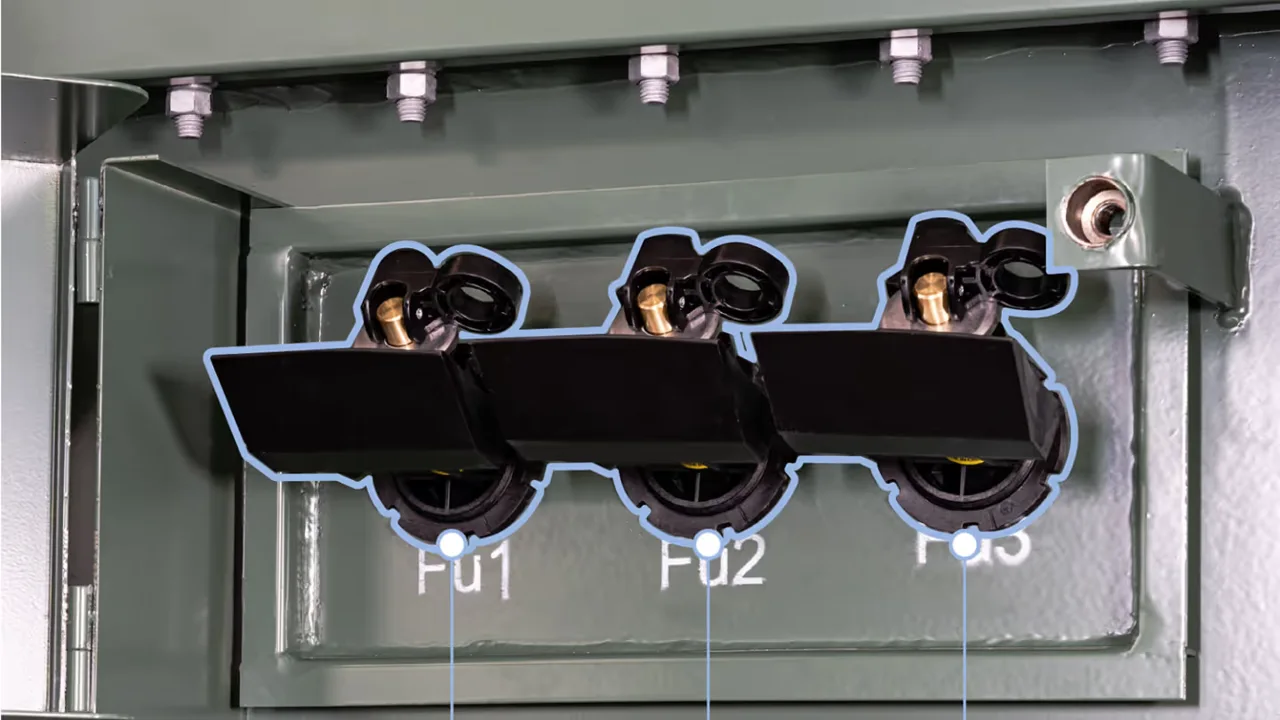
Bayonet fuses are expulsion-type fuses that sit submerged in transformer oil. One advantage of bayonet fuses is that they are dual-sensing devices, meaning they respond both to overcurrent and excessive heat, making them more effective than simple overcurrent fuses, especially if your transformers have a lot of thermal stress from variable loads or high external temperatures.
These fuses are standard on many padmount transformers. They protect against secondary-side faults and sustained overloads in addition to the thermal stress we discussed earlier. The typical rating on a bayonetfuse is 1.5 to 2 times the transformer’s full-load amperes, meaning it’s sized to handle inrush current while coordinating with downstream protection.
Accessibility is one of the biggest advantages of a bayonet fuse system. They have a plug-in design that allows for convenient, front-compartment access without draining oil. They're cost-effective and respond in milliseconds to seconds, depending on fault magnitude.
Limitations of bayonet fuses relate to fault magnitude. They’re not designed for faults exceeding 10,000A. They also can’t be reset after operating and require careful sizing to avoid nuisance tripping during transformer inrush.
All Giga padmount transformers include properly sized bayonet fuses coordinated with the transformer's thermal characteristics and site-coordinated performance requirements. We handle the engineering work upfront and provide ongoing support.
Read More: Types of Transformers (and What They're Used For)
Current-limiting fuses (CLFs)
Current-limiting fuses are fast-acting electrical safety devices. These sand-filled devices are installed inside the transformer tank as a backup to protect circuits and equipment from damaging overcurrents and short circuits. When a severe fault occurs, the arc melts the fuse, and the sand inside absorbs the arc energy, creating high resistance that limits peak current.
We recommend CLFs for most transformers of any KVA. When available fault current exceeds the interrupt rating of your secondary fault protection fuses (generally 2500A), you will absolutely need a CLF. They're standard for data centers, industrial facilities with high fault current, and any mining operations connected to utility transmission.
Partial-range CLFs (backup fuses) are the most common use case for CLFs. These fuses rely on bayonet fuses for overload protection and only handle high-magnitude faults.
Isolation links
An isolation link is another fuse type used in conjunction with expulsion-style fuses. These devices are simple fusible links that melt during an internal transformer fault, creating an open circuit that prevents re-energizing a failed transformer.
The key difference between an isolation link and a CLF is that isolation links don’t limit current fault magnitude; they simply open the circuit after a fault has already occurred. These devices work well for smaller transformers under 500 kVA or temporary installations.
The advantages are cost and simplicity. Isolation links cost significantly less than CLFs, with easier installation and replacement. The trade-off is there is no current-limiting action, and some utilities don’t accept them.
Low voltage secondary fuses
Low voltage secondary fuses install on the secondary side of the transformer to protect downstream equipment from overcurrent conditions. However, these fuses are rarely specified in modern padmount transformer installations due to cost and impracticality.
In most applications, primary-side fusing provides adequate protection for both primary and secondary faults. Bayonet fuses on the primary side can detect and clear secondary-side faults, eliminating the need for redundant secondary protection. The current levels required for effective secondary-side fusing are typically so high that it becomes more economical to rely on primary protection and let downstream circuit breakers or equipment-level protection handle any localized faults.
When secondary fuses are used, they’re almost always customer-supplied rather than factory-integrated. You’ll occasionally see them in specialized applications like large industrial facilities with complex feeder arrangements or data centers requiring granular fault isolation at the distribution level. Still, even in these cases, the protection strategy usually defaults to primary-side fusing combined with downstream breakers.
Dual-Sensing Fuses
Dual-sensing fuses monitor both current and temperature simultaneously. They respond to overcurrent like standard fuses, but also trip when they detect excessive heat, even when the current stays within the rated range. This dual-trigger mechanism provides more comprehensive protection against both electrical overloads and thermal failures that might not show up as obvious overcurrent conditions.
However, dual-sensing fuses aren't necessarily standard on most transformer orders. They're harder to procure than conventional bayonet fuses and typically carry lower current ratings, which can limit their application in high-capacity installations.
Dual-sensing fuses can make sense in particularly hot climates, variable load applications that cause thermal cycling, applications with harmonic loads, and electrical transformers operating near maximum capacity.
ELSP (Energy Limiting Surge Protection) fuses
ELSP fuses are specialized current-limiting fuses with surge energy absorption. They limit current during faults, like standard CLFs, and absorb energy during surge events from lightning or switching operations.
Lightning-prone regions, like the Gulf Coast, Southeast, Florida, and mountain areas, may want to explore these devices. Critical loads that can't tolerate surge failures, expensive transformers, and remote sites where replacement is difficult are other applications that justify the steep cost of ELSP fuses.
Common fuse selection and specification mistakes
We’ve installed a lot of fuses, so we’ve seen what works and what fails. More importantly, we’ve seen how the same specification mistakes cause project delays, equipment damage, and expensive rework. Here are some of the most common mistakes we’ve seen and how to avoid them.
Mistake 1: Not coordinating fuse ratings with transformer size
One of the most common mistakes we see is assuming that a “standard” fuse rating will work, without checking transformer specs. Contractors and procurement teams sometimes default to common ratings they've used before, not realizing that fuse sizing needs to match the transformer's actual full-load amperes and characteristics.
Most often, we see this mistake when teams are trying to move too fast. Someone copies specifications from a previous project or assumes something is one-size-fits-all. In the end, the project gets derailed by nuisance tripping, blown fuses, or damaged transformers during faults.
How to avoid it:
Bayonet fuses should be rated at 1.25 to 1.5 times the transformer's primary-side full-load amperes (calculated at the full-capacity below nominal tap, typically 95% voltage). Current-limiting fuses should be 2 to 3 times FLA. Both ratings need to be verified against the transformer nameplate and selected from standard fuse ratings — not guessed.
You also need to account for transformer inrush, which can spike to 8 to 12 times full-load current for a tenth of a second during energization. The fuse must handle this without blowing, while still protecting against sustained overcurrent.
Giga includes properly sized fuses with every padmount transformer. You don't have to calculate anything. We size the fuses correctly and ship them installed. It's one less thing that can go wrong.
Mistake 2: Using the wrong fuse type
Another common mistake is specifying the wrong equipment altogether, like listing an isolation link when the utility requires a current-limiting fuse. This mistake happens when teams don’t check utility interconnection requirements before ordering transformers, or assume they can substitute one for the other to save money.
The cost is a failed interconnection inspection. The utility rejects your transformer because it doesn't meet their protection standards. Now you're stuck retrofitting or ordering a new transformer. Either way, you're facing delays and revenue loss.
How to avoid it:
Check utility interconnection standards before you finalize transformer specifications. Some utilities require CLFs for all transformers regardless of size or available fault current. Others allow isolation links for small transformers under specific conditions. Don’t assume; make sure you know before you order.
Mistake 3: Not keeping spare fuses on site
We’ve seen teams operate under a "we'll order them when we need them" philosophy, not realizing that fuse delivery can take days or weeks, depending on rating and availability.
The cost that comes from this mistake is downtime. Your transformer loses power because a bayonet fuse blew. If you don't have spares on site, you're waiting for shipping while your facility sits dark.
For data centers, every minute of downtime has a dollar cost. For mining operations, a blown fuse can cause a drop in hashrate, which means lost Bitcoin revenue. For industrial facilities, production halts, and you're losing thousands of dollars while waiting for a fuse that would have cost $150 upfront to have on hand ahead of time.
How to avoid it:
Stock at least one full set (3x) of spare bayonet fuses per transformer with the same rating as what's installed, and train your maintenance staff on fuse identification and replacement so they can act fast when needed.
Mistake 4: Ignoring fuse coordination with upstream protection
Another common mistake is failing to ensure that your transformer fuses coordinate with utility breakers or reclosers. A lot of teams focus on sizing fuses for the transformer but forget to consider how those fuses interact with upstream utilities.
The cost is operational confusion when faults occur. The wrong device operates during a fault, and now troubleshooting takes longer because the fault location isn't where you expected.
How to avoid it:
The downstream device (your transformer fuse) should clear faults first. The upstream device (the utility breaker or recloser) should only operate if the transformer fuse fails to clear the fault. This coordination requires a proper fault protection coordination study to verify sequencing and set you up for reliable operation under fault conditions, so don’t skip this step.
Fuse selection criteria
Next, let’s cover a practical framework you can use for fuse selection, whether you’re specifying a single transformer or outfitting an entire site.
Start with transformer specifications
Everything begins with the transformer nameplate. The full-load amperes listed there drive all fuse sizing decisions.
For bayonet fuses, multiply FLA by 1.25 to 1.5. For current-limiting fuses, multiply by 2 to 3. A 1500 kVA transformer with a primary voltage of 12,470V has a full-load line current of approximately 69.5A. When accounting for the full-capacity before nominal tap at 95% voltage, this increases to roughly 73.1A. Based on standard fuse ratings, this transformer would typically be protected by 100A bayonet fuses and 150A current-limiting fuses.
Next, check the voltage rating. You need to spec fuses that match the primary voltage class. Be sure to verify these against the transformer nameplate rather than making assumptions based on past projects or industry standards.
Transformer impedance is another critical consideration. Lower impedance means higher inrush, requiring more robust fuses that won't nuisance trip during energization. The cooling class matters too. ONAF transformers with forced-air cooling can handle 15 to 33% overload, so size fuses for actual operating capacity, not just ONAN ratings.
Determine available fault current
The available fault current at your site determines whether you will need current-limiting fuses and, if so, how they’re sized. This figure isn’t something you should estimate. Instead, get the actual data from the utility short-circuit study provided during interconnection.
- Low fault current under 5,000A means an isolation link may be acceptable if utility standards allow it.
- Medium fault current from 5,000A to 15,000A usually requires a CLF.
- High fault current exceeding 15,000A definitely requires a CLF and may need special ratings.
The CLF's interrupting rating must exceed the available fault current. Common ratings are 25kA, 40kA, and 50kA. Pick the rating that covers your site's available fault current with a margin.
Account for environmental conditions
Standard fuse ratings assume 40°C ambient temperature (104°F). If your site runs hotter, fuses need to be derated or you need higher ratings to compensate. For Texas, Arizona, or other hot climates, you’ll want to consider dual-sensing fuses.
Lightning exposure is a concern for sites in high-activity areas. If you operate in the Gulf Coast, Southeast, or mountainous areas, you should consider ELSP fuses in addition to surge arresters for enhanced surge protection.
Altitudes above 3,300 feet may require derating fuses or using higher-rated fuses, though this is rare in most applications. For most industrial and data center applications in typical environments, standard fuse ratings work fine.
Match fuses to load characteristics
If your data center has a stable, 24/7 load, fuse sizing is simple. You’ll need to size for steady-state conditions, allowing for growth.
If your site operates with variable loads, things get more complicated.
Mining operations running demand response see load swings as they curtail for grid events. Size your fuses for maximum expected load, not average load. Industrial facilities with motor starting, process variations, and surge currents also need to take this variability into account.
Read more: Key considerations when choosing transformers for Bitcoin mining
ASIC miners, GPU power supplies, and VFDs generate harmonic content that can increase heating in transformers and fuses. If your system's total harmonic distortion exceeds 5%, you need to account for this in your fuse sizing and thermal design.
Coordinate with utility protection
Your transformer fuses are part of a protection system that includes upstream utility breakers or reclosers and downstream equipment protection. You need to account for this coordination when selecting your fusing options.
The principle is simple: downstream devices should operate first. Your transformer's bayonet fuse should clear secondary faults before the utility's recloser operates. The CLF should clear internal transformer faults before upstream utility protection trips.
This requires time-current curve analysis. The fuse's operating time at various current levels needs to be faster than upstream protection but slower than downstream protection. Get this wrong, and the wrong device operates during faults, making troubleshooting and repairs a lot more complicated.
Verify compliance and standards
Finally, verify all compliance and required standards. Your fuses must meet applicable IEEE, ANSI, and UL standards. Utility specifications often require you to meet these standards, and sometimes add their own requirements.
Verify that your voltage, current rating, and fuse model are utility-approved before proceeding.
Put it together: Fuse selection process
Here’s a simple, step-by-step breakdown of the fuse selection process we’ve just covered:
Step 1: Get transformer specifications from the nameplate, including voltage, kVA, full-load amperes, impedance, and cooling class.
Step 2: Obtain the available fault-current data from the utility interconnection study.
Step 3: Assess site environmental conditions, like ambient temperature, lightning exposure, or any other unusual factors.
Step 4: Consider your load characteristics, including any harmonic or variable considerations.
Step 5: Check utility interconnection requirements for protection coordination and approved equipment.
Step 6: Size bayonet fuses appropriately. Be sure to account for inrush and coordinate with downstream protection needs.
Step 7: Determine if CLF or isolation link is required based on fault current and utility standards. Size CLFs at 2-3× FLA with appropriate interrupting rating.
Step 8: Consider special protection like dual-sensing fuses for hot climates or ELSP fuses for lightning-prone areas.
Step 9: Verify coordination with both upstream utility protection and downstream equipment protection.
Step 10: Document everything for utility approval and future reference.
You can either follow those ten steps to the letter or skip all that and work with Giga's engineering team. We size fuses for every transformer we build based on transformer nameplate ratings and standard protection practices. All you’ll need to do is verify coordination with your specific utility requirements and site conditions. Then, we ensure that the fuses that arrive pre-installed are sized correctly for your application and are documented for all required approvals.
Best practices in transformer fuse selection and maintenance
If you want to keep your transformers reliable, safe, and running smoothly, you need to follow maintenance and upkeep best practices.
- Regular Inspections: Regularly inspect fuses for wear, damage, or improper installation. Early detection prevents unexpected failures and extends the lifespan of fuses and transformers.
- Adherence to Manufacturer Guidelines: Always follow the manufacturer’s recommendations for fuse ratings and replacement procedures.
- Performance and Replacement Records: Keep detailed records of fuse performance and replacements to identify patterns or recurring issues that may indicate transformer or environmental problems.
- Environmental Monitoring: Monitor environmental conditions near transformers. Changes in temperature, humidity, and corrosive exposure can affect fuse performance. Adjust maintenance schedules accordingly.
- Training and Awareness: Ensure maintenance personnel are trained on fuse types and maintenance requirements. Knowledgeable staff can more effectively manage fuse selection, maintenance, and replacement, reducing errors that compromise transformer protection.
- Upgrade Plans: Develop a plan to upgrade or replace fuses as part of broader system upgrades. Protective fuses evolve with transformer technology, and upgrading them enhances system reliability and addresses changing electrical demands.
- Safety Compliance Checks: Regularly review and update safety procedures for fuse handling and replacement. Compliance with safety standards protects maintenance personnel and ensures the electrical system is safe.
- Collaboration with Manufacturers: Maintain open communication with fuse manufacturers to stay current on product specifications and new technologies.
Following these strategies is critical to keep your fuses in good working order and operate efficiently (and safely).
Get padmount transformer fusing right from the start
Fuses are your data center’s last line of defense between a fault and a catastrophic failure. If you select the wrong fusing options for padmount transformers, you’ll face project delays, equipment damage, and downtime that costs more than the transformer itself.
But you don’t have to become a fuse coordination expert to get things right. When you work with Giga Energy for your projects, you get correctly sized and coordinated fuses with every padmount transformer you request. Our engineering team handles coordination studies, utility interfaces, and the documentation you need for interconnection approval.
Ready to spec transformers with fusing done right? Build a quote or contact our team to discuss your project. We'll ensure your fuses protect your investment rather than become a problem.